CORPUS CHRISTI, Tx — The city of Corpus Christi is reversing two key positions on its Level 1 water emergency plan, backing away from statements made as recently as last week.
City Manager Peter Zanoni announced Friday that the city will ask the City Council to raise the residential water baseline from 7,000 to 8,000 gallons per month and will recommend that large-volume industrial water users be required to pay surcharges during a Level 1 emergency — even if they paid into a program that was supposed to exempt them.
Both proposals are expected to go before council for a vote Tuesday, May 13.
Baseline reversal
One week ago, Corpus Christi Water COO Nick Winkelmann told KRIS 6 News that raising the 7,000-gallon residential baseline was not an option.
"It doesn't make sense to artificially raise a number. We know where we need to hit. We know where the averages are for the system to remain stable in the event we get to a Level One Water Emergency," Winkelmann said at last week's briefing.
On Friday, Zanoni announced the city is doing exactly that.
Under the new proposal, the monthly residential baseline would increase to 8,000 gallons. After a 25% curtailment is applied, residents would be asked not to exceed 6,000 gallons per month — up from the previously proposed 5,250-gallon allocation.
When KRIS 6 News asked what specific data analysis or expert recommendation drove the reversal, and who made the decision, Zanoni did not cite new data. Instead, he said approximately 30% of residential customers currently use more than 5,250 gallons per month, and that 6,000 is a round number that better aligns with the city's billing practices.
"It's one that we use or talk about a lot when it comes to budgeting and rate setting," Zanoni said.
KRIS 6 News also pressed the city on whether raising the residential baseline could prompt wholesale or large-volume users to demand their own baselines be raised. Zanoni said he does not expect that outcome, arguing that the three-year averaging methodology used for those customers would still give them more water than they currently use.
Under the new proposal, residential customers who exceed their 6,000-gallon allocation will not be fined and will not have their water shut off. Fines will still apply to customers caught violating Stage 3 restrictions, such as irrigating landscaping.
Surcharge exemption reversal
The second major reversal involves roughly 10 large-volume industrial customers who enrolled years ago in a voluntary drought surcharge exemption program, paying an extra 31 cents per 1,000 gallons. In exchange, they were shielded from paying surcharges during drought restrictions.
Until now, the city had confirmed that protection extended to a Level 1 water emergency. That position led to a tense exchange at a previous City Council meeting, when District 5 Councilman Gil Hernandez asked: "So were we misinformed or misled the entire time?" CCW COO Winkelmann replied: "I can't answer that."
On Friday, Zanoni said the city will now recommend to council that those exempt users should pay surcharges during a Level 1 emergency regardless of the fee they paid.
His argument: the old drought contingency plan had four stages, and the exemption language applied to Stages 1 through 4. The updated plan, approved roughly a year ago, eliminated Stage 4 and created a new category called the "Level 1 Water Emergency." Zanoni said nowhere in the updated documents does it say exempt users are protected from surcharges under that new classification.
"It doesn't say it anywhere," Zanoni said. "But there's a nuance — there's interpretation."
When KRIS 6 News summarized the position — asking whether the city now believes exempt large-volume users are not exempt from surcharges under a Level 1 emergency — Zanoni confirmed it.
"We're going to recommend that they are not exempt," he said.
Zanoni said surcharges are a more effective compliance tool for large industrial customers than fines.
"A $500 fine is not going to do anything to a multi-billion dollar corporation," Zanoni said. "Surcharges we think would be a better tool to keep them within line."
The city said it has begun conversations with large-volume industrial partners ahead of Tuesday's vote, but no agreement has been reached. The surcharge exemption program generates roughly $6 million annually for the city.
Other updates from Friday's briefing
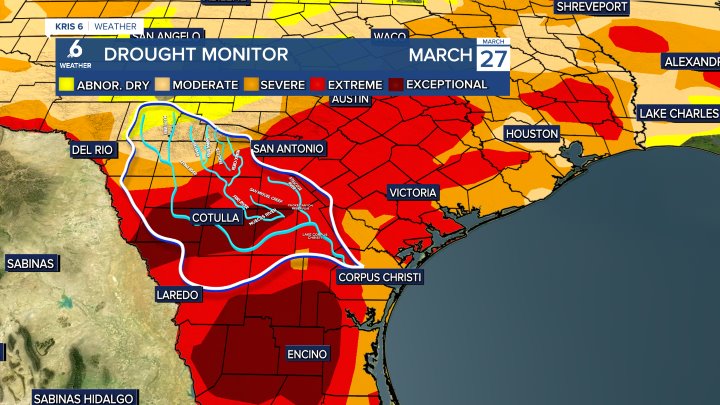
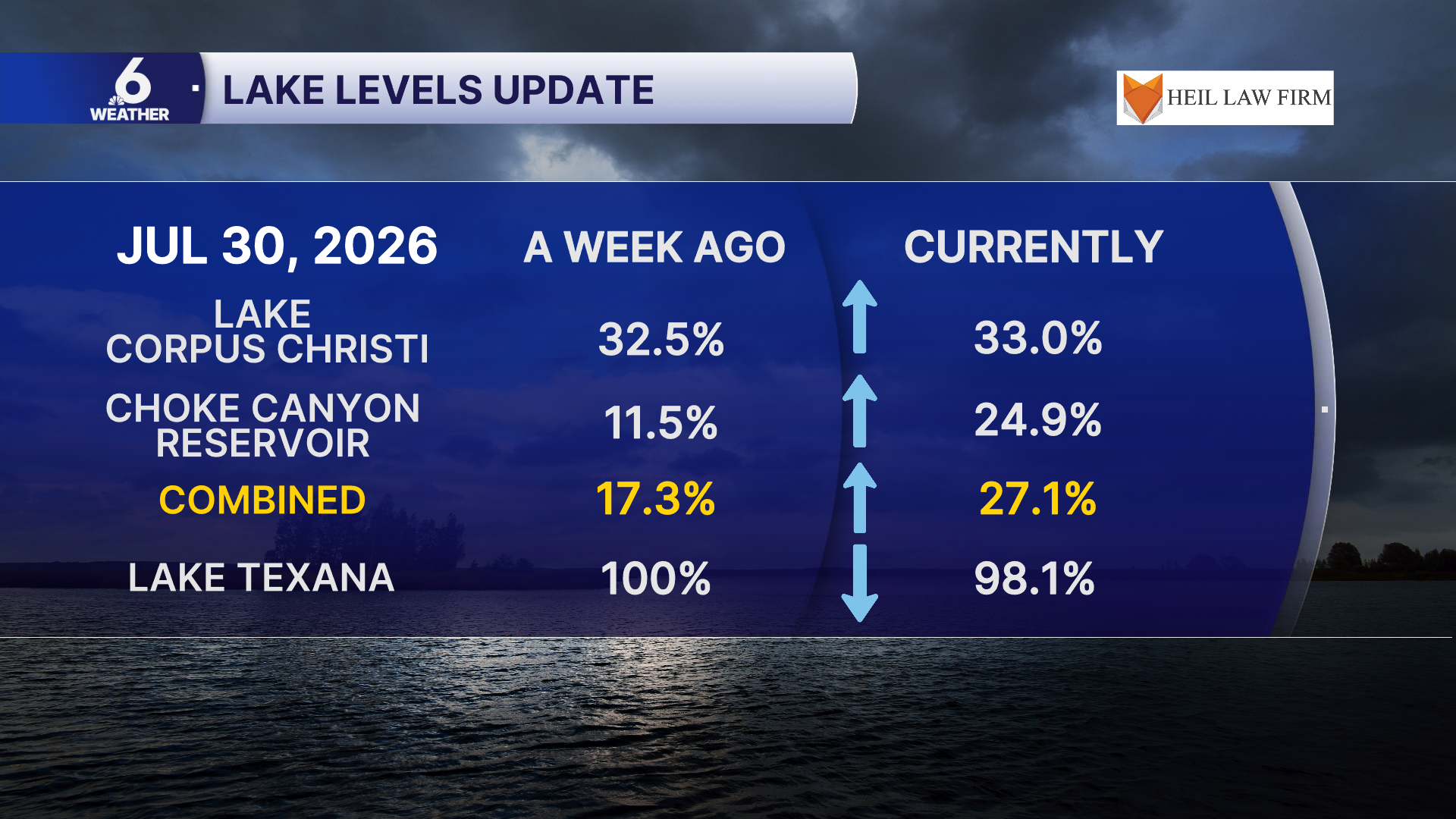
- Zanoni said the city's water supply outlook has improved since last month's projection that a Level 1 emergency would be triggered in September. Lake Texana has risen from approximately 49% capacity to 79% in recent weeks, and the Lower Colorado River is flowing well, currently supplying about 30 million gallons per day. Combined western reservoir levels — Choke Canyon and Lake Corpus Christi — remain critically low at 8.2% capacity. Zanoni said an updated forecast model could push the September Level 1 declaration date back by one to two months. A new model run is expected to be presented to council at either the May 19 or May 26 meeting.
- A web-based residential water usage lookup tool is expected to launch next week, pending council approval of the curtailment policies Tuesday. Customers will be able to enter their account number and address to see their water use to date, historical usage and average daily use from their prior billing cycle.
- Residents who use more than 6,000 gallons per month for legitimate reasons — such as large families or medical needs — will be able to apply for a variance. Zanoni said the process will be a simple one-page form, handled confidentially by Corpus Christi Water staff, and will not require medical records. He said most variance requests are expected to be approved.
- The city had previously discussed reducing hours at its four seasonal pools, two aquatic centers and five splash pads this summer. Zanoni announced Friday the city will no longer modify those hours, instead focusing on operational changes — including ensuring all municipal pools have covers — to reduce water consumption.
- A decision from administrative law judge Alicia York on the Evangeline groundwater project permits is expected by Tuesday, May 12 — the 10th business day of her review period.
- The far-field environmental modeling process for the proposed inner harbor desalination facility continues, with two public meetings remaining — May 21 and May 28.