


CORPUS CHRISTI, Tx — Editor's note: This story has been updated to provide clarity from the city regarding enforcement.
A draft city council workshop presentation obtained by KRIS 6 News projects Corpus Christi could enter a Level 1 Water Emergency by September 2026 and recommends cutting water use by 30% for all water users.
The city council is scheduled to discuss the plan on Tuesday at 10 a.m.
Under the city's drought contingency plan, a Level 1 water emergency is declared if the city is within 180 days of not being able to meet water demand.
From six scenarios to one
The September projection marks a significant narrowing of the city's public outlook. At a March 17 city council meeting, Corpus Christi Water presented five scenarios, ranging from a Level 1 emergency as early as May to one scenario that could avoid an emergency altogether. This draft presentation models only one scenario — and it projects September.
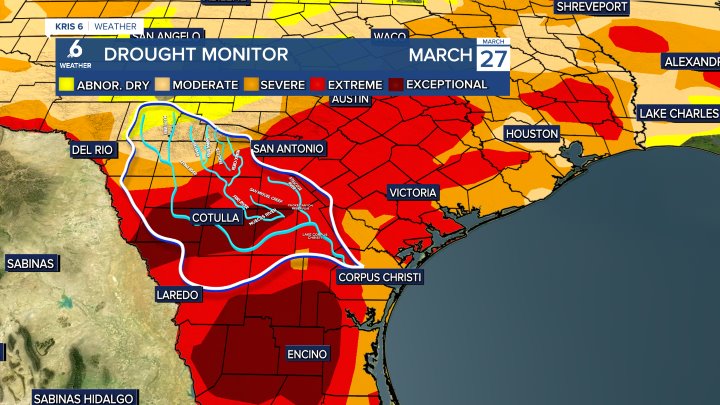
That shift follows the well field setback KRIS 6 reported last week. The city had counted on its western well field — a newer set of wells with lower salt content — to pump more of its permitted capacity. That assumption proved wrong.
"Even with half the level of TDS, we're still only able to pump about half the water we could pump into the river," City Manager Peter Zanoni said Thursday. The city's 14 wells, which could produce 21 million gallons per day at full capacity, have been limited to roughly 14 million gallons per day under state water quality rules.
The Texas Commission on Environmental Quality requires the city to monitor salt content — measured as total dissolved solids — in water discharged into the Nueces River, which the city uses to move well water to the O.N. Stevens Water Treatment Plant. When salt levels get too high, the city must reduce pumping.
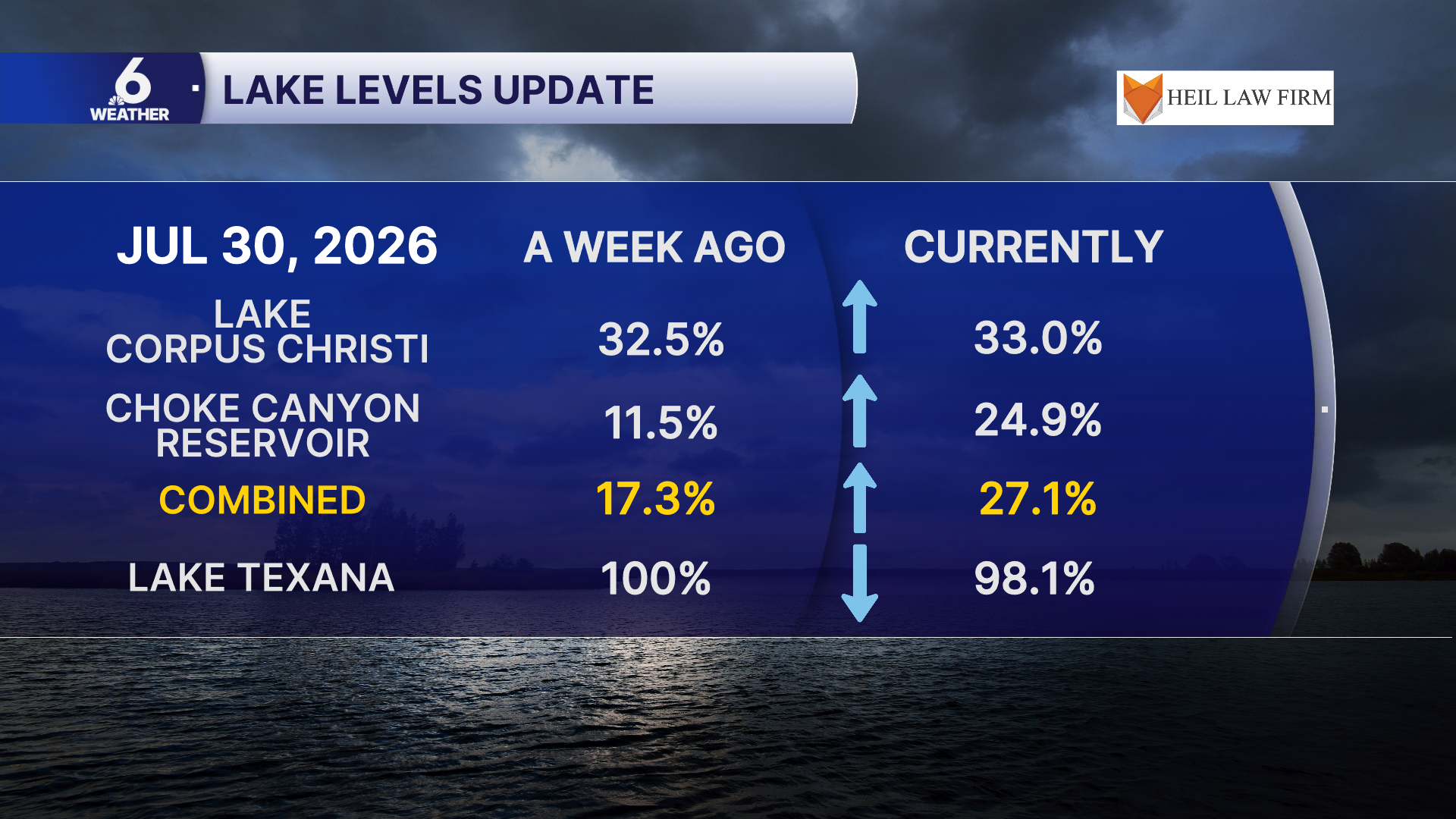
As of Monday, Choke Canyon Reservoir and Lake Corpus Christi stand at a combined capacity of 7.8%, with no signs of natural recovery.

Enforcement question looms over the plan
The draft states that under a Level 1 emergency, "surcharges may be the only tool available to enforce water cuts for commercial and large volume users who exceed their allocation." Meter cutoffs, the draft says, would only be considered under a Level 2 Water Emergency. The draft adds that the city's legal team will need to be consulted.
About 10 large industrial customers are permanently exempt from surcharges. Those customers enrolled years ago in a voluntary program, paying an extra 31 cents per 1,000 gallons, which bought them a permanent exemption from drought surcharges — including during a Level 1 Water Emergency. The city confirmed that exemption remains in effect.
Those customers would still be required to cut their water use by 30% along with everyone else. But if they do not, the city's primary financial penalty tool would not apply to them.
On Monday, the City told KRIS 6 News, "a customer who exceeds their allocations, including large-volume users, could be issued a citation for each violation. This would have to go through the court system. After two convictions, CCW would have the authority to turn off that customer’s water through their next billing cycle. This could include large-volume users. As a reminder, large volume users who have opted to pay the drought surcharge exemption fee are NOT exempt from curtailment."
At a previous media briefing, Zanoni said the city has no plans to physically shut off industrial customers, citing safety concerns, and that usage would be monitored through meter data. The city later said that state law does allow it to cut water to exempt industrial users if they fail to reduce consumption during a water emergency. This draft presentation states the city may not be able to enforce cuts even if users do not reduce consumption.
Bob Paulison, executive director of the Coastal Bend Industry Association, said the city still lacks clear answers on enforcement.
"We need to have clear direction," he said, adding that fundamental questions remain unanswered after more than a year of working with the city on Level 1 planning.
"When is it going to happen? What is my allocation going to be? How are we going to manage the allocations? How do I know that those allocations are fair? How are they going to be enforced?" he said. "We've been encouraging them to try to get set on what they think will work best for the region, and that's been difficult to achieve so far."
What the cuts would mean for customers
The draft recommends a 30% reduction — called curtailment — applied to all customer types once a Level 1 emergency is declared. Each customer's allocation is their baseline water use minus 30%.
For residential customers, the recommended baseline is 7,000 gallons per month. After a 30% cut, the monthly allocation would be 5,600 gallons.
According to the presentation, "residential use that goes over the allotment should be enforced through the surcharge."
For multifamily housing, commercial businesses, wholesale customers, and large volume users, individual baselines would be calculated from each customer's own usage history between 2022 and 2024.
Paulison said a 30% cut is at the outer edge of what large industrial users have been planning for.
"That is gonna be — that's at the extreme end," he said.
He said companies are committed to avoiding shutdowns but will need to pursue additional options between now and September to stay within their allocations.
Who the large volume users are
The draft identifies two groups of large-volume industrial water users.
Corpus Christi's direct, large-volume customers are: Citgo, Flint Hills, Valero, HEP Javelina, Calpine, Lyondell Basell, Celanese, EPIC/Coastal, STX Beef, and Utility Processing at Naval Air Station Corpus Christi.
Large-volume users under the San Patricio Municipal Water District wholesale arrangement are: Air Liquide, ArcelorMittal, Chemours, CC Liquefaction (Cheniere), Gulf Coast Growth Ventures, GPP NRG, Ingleside Ethylene, Ingleside Cogen, Nashtech, Occidental Chem, and Steel Dynamics.
Pools, splash pads, and outdoor watering
Under a Level 1 emergency, the draft recommends:
- Closing two city swimming pools and two splash pads
- Reducing hours at remaining pools to three days a week
- Opening splash pads only Friday through Sunday
- Requiring covers on all pools to reduce evaporation
- Banning landscape irrigation using city water
- Allowing potted plants to be watered
- Banning vehicle washing using city water; alternate water sources such as captured rainwater or well water may be used
What's next
Paulison said industrial users are pursuing every available option to reduce dependence on city water, starting with internal efficiency measures before looking outward.
Companies are exploring recycling cooling tower blowdown water, capturing stormwater, and reusing effluent from on-site wastewater treatment plants. Some, including Valero, Flint Hills, and Citgo, are examining municipal wastewater reuse. Others are weighing private wells, though Paulison said companies are proceeding carefully given concerns about impacts on neighboring wells.
"Everything is on the table," he said. "There are no bad ideas. If there is some idea to get water here, it's on the table and it's being evaluated."
Options under consideration also include barge-mounted desalination, tanker trucks, trains, and water barges.
The city council is scheduled to vote on a formal Level 1 Water Emergency Plan on April 28. That vote will determine what residents, businesses, and large industrial users would be required to cut and whether higher water bills would follow.
The draft lists community engagement meetings scheduled from April through September across city districts, including Port Aransas, The Island, Calallen, and Districts 1 through 5.