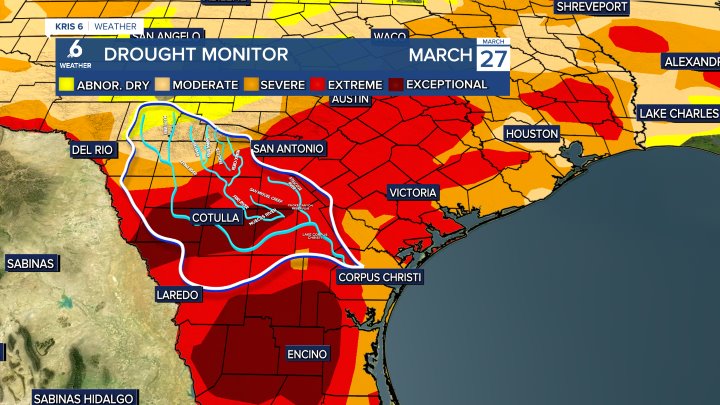


CORPUS CHRISTI, Tx — An internal city document obtained by KRIS 6 News through a public information request shows Corpus Christi has revised its water supply targets downward and is seeking permission from the state to bypass its own water quality monitoring plan.
The March 11 document — an abbreviated water overview sent to the State Legislative Delegation by Ryan Skrobarczyk, the city's Director of Intergovernmental Relations — was described as "a simplified version of our weekly memo that outlines the most immediate new supply projects with the state permits we are waiting on."
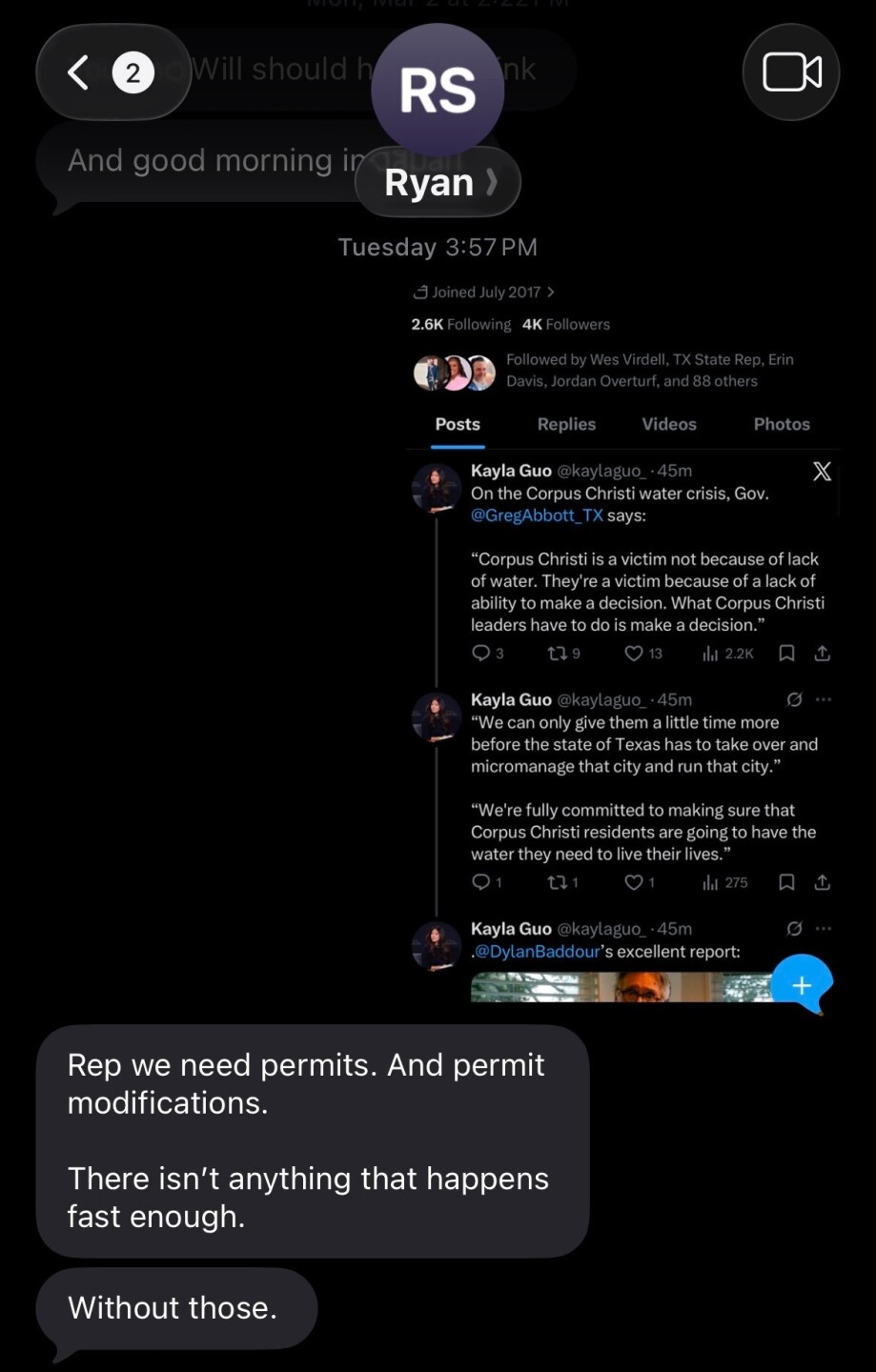
The urgency behind that description is underscored by a text message also obtained by KRIS 6 News through a public information request. In it, Skrobarczyk privately wrote to State Rep. Denise Villalobos: "Rep we need permits. And permit modifications. There isn't anything that happens fast enough. Without those."
City officials had previously told KRIS 6 News the city needed 60 million gallons of new water per day before November 2026 to avoid a Level One water emergency.
The document puts the target differently. It says the city must replace 50 million gallons per day with alternative supplies — and warns that a projected 10% reduction by the Lavaca-Navidad River Authority, expected as early as April 20, could push the gap to approximately 54 million gallons per day. A possible second 10% cut later this summer could widen it further.
Given the potential for the Choke Canyon and Lake Corpus Christi reservoirs to be fully depleted under the worst-case forecasts in early summer, the City of Corpus Christi must replace 50 MGD of water with alternative water supplies. This assumes there is no cut to the water under the LNRA Drought Contingency Plan. If the LNRA enacts the projected April 20, 2026, reduction of 10% then the gap in water supply increases by approximately 4 MGD, with the potential for another 10% (total of 20% reduction) this summer. The following groundwater projects will bring an additional 40 MGD this year which will limit use of the western reservoirs and provide an opportunity for their recovery.
The document projects 40 million gallons per day in new water coming online across all of 2026. But a closer look at the numbers shows that figure is largely dependent on outcomes the city does not control.
Of that 40 million gallons per day, 17 million gallons — the entire Nueces County Western Well Field — cannot be delivered without the Texas Commission on Environmental Quality (TCEQ) approving a bed and banks permit. In a text to council this month, Zanoni wrote that several people have objected to that permit, and that the best-case scenario for approval is May — though it could take longer depending on the number of objections. The Ed Rachal Foundation property's 9 million gallons per day is tied to that same permit. If it is delayed, both projects stall together.
Another four million gallons per day projected from the Evangeline project by November 2026 faces a separate and more advanced legal obstacle. The document states that projection assumes "no contested case hearing" on the San Patricio County Groundwater Conservation District permits. As KRIS 6 News previously reported, those permits are already in a legal hearing process after the City of Sinton and St. Paul Water Supply Corporation filed formal protests — a process that is already underway.
The Nueces County Eastern Well Field, which is already producing four million gallons per day, is designed to produce 10 million gallons per day. The document says the city has applied to TCEQ for an emergency order to unlock the remaining six million gallons per day. If that emergency order is granted, the Eastern Well Field's full 10 MGD would bring the city's total new supply to 40 million gallons per day in 2026. That figure still falls well short of the city's stated gap of 50 million gallons per day, before accounting for potential LNRA cuts.
In sum: virtually every gallon in the city's 2026 projection requires either a new permit approval, a permit modification, or a favorable legal outcome in a proceeding that has already begun. Even under the most optimistic scenario — in which all permits are granted and no legal hearings delay Evangeline — the document's own numbers leave a significant gap between projected supply and the city's stated need.
At Friday's briefing, City Manager Peter Zanoni was asked whether the projected new supply is enough to avoid curtailment. He did not answer the question directly.
"The simple math is we're trying to replace 70 million gallons," Zanoni said, referring to what the western reservoirs once produced at full capacity. "We have 76 million gallons of new water sources."
He was referring to the full buildout of all projects — a figure the document shows will not be reached until 2028 at the earliest.
The Eastern Well Field is already falling short
The document reveals the Eastern Well Field — the city's first Nueces County groundwater project — has been producing just four million gallons per day against a permitted capacity of 10 million gallons per day. Zanoni confirmed Friday the reason why.
"Because of the management plan that we have for water quality on salt, on TDS (Total Dissolved Solids), we're not able to put 10 million in, and we haven't been for the past couple of months," he said.
The city has applied to TCEQ for an emergency order to unlock the remaining six million gallons per day. The document argues that the higher-TDS water from the wells would actually be beneficial — saying the increased volume "will dilute the arsenic in the system" as the reservoirs continue to deplete.
As KRIS 6 News previously reported, residents near city well outflows along the Nueces River have recorded TDS readings more than five times the federal drinking water standard. Downstream, TDS levels at the treatment plant serving Robstown more than doubled from a 15-year average of around 700 to approximately 1,500.
The monitoring bypass request
The document states that once TCEQ issues the Nueces County Western Well Field bed and banks permit, "City staff will apply for a special condition that allows the city to bypass the monitoring plan in the event of reservoirs being below 10% combined capacity."
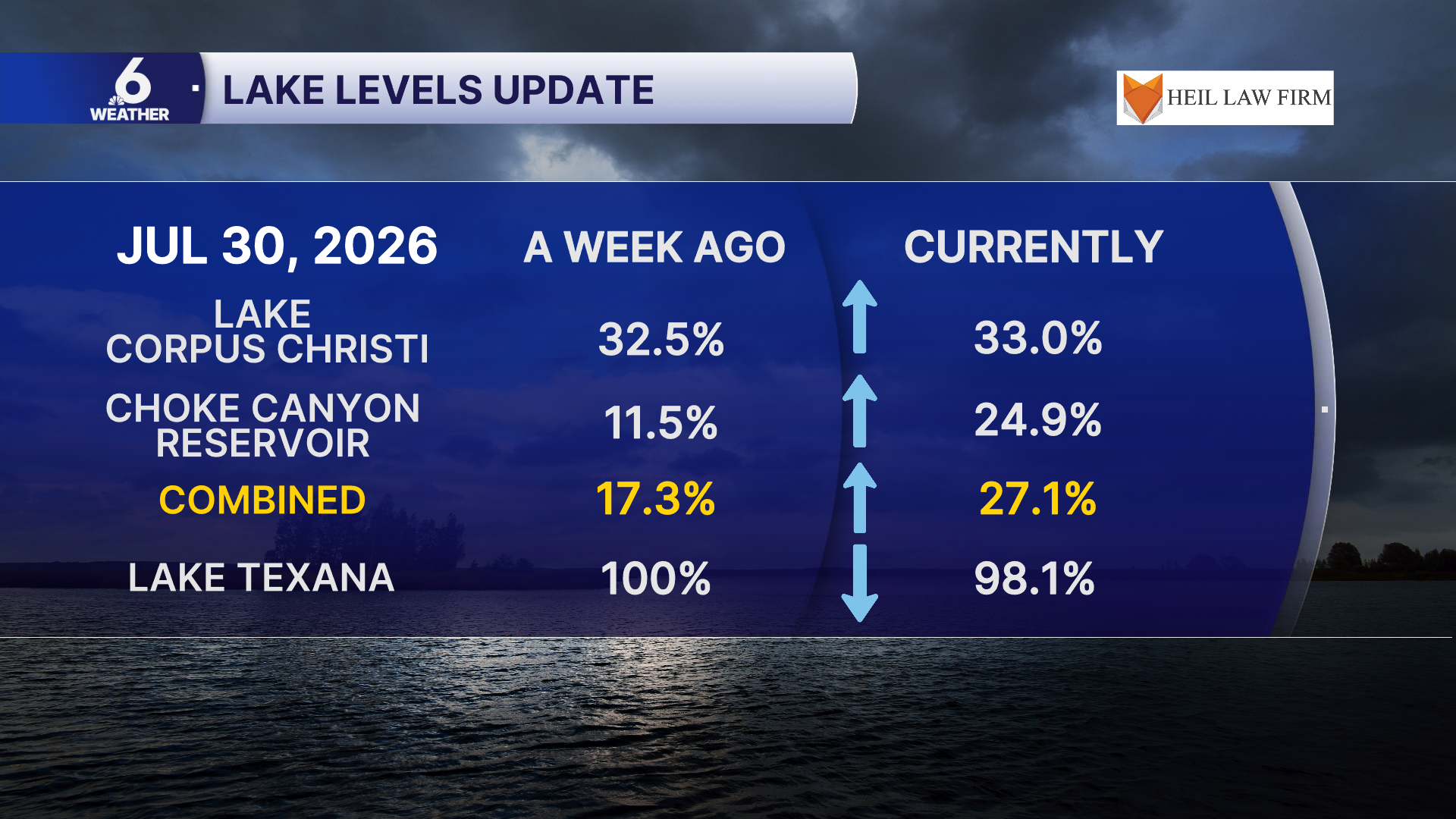
Those reservoirs have already fallen below 10 percent combined capacity and are currently at a combined capacity of 8.5 percent.
The monitoring plan the city wants to bypass is the same type of water quality safeguard that is currently preventing the Eastern Well Field from running at full capacity. The city is asking TCEQ to ensure that restriction cannot be applied to the Western Well Field under drought conditions.
When the city's own aquifer story and recovery conservation district approved Western Well Field permits in December, it required the city to implement a well-field monitoring program within 60 days, specifically because of community concerns about pumping impacts on private wells and water quality.
The multi-year picture
The document's delivery table — which projects water production through 2028 — shows the city's full water supply plan extends well beyond the November 2026 deadline.
The Evangeline project is shown delivering water across three years: five million gallons per day total in 2026, 16 million gallons per day spread across 2027, and a final three million gallons per day in 2028 — reaching its full projected capacity only at the end of that year. Effluent reuse contributes just one million gallons per day in 2026, with industrial reuse contracts not reaching full volume until 2027.
The city has publicly described these projects as solutions to the November 2026 deadline. The document shows the majority of projected new water does not arrive until after that date.
Lake Texana — a new concern
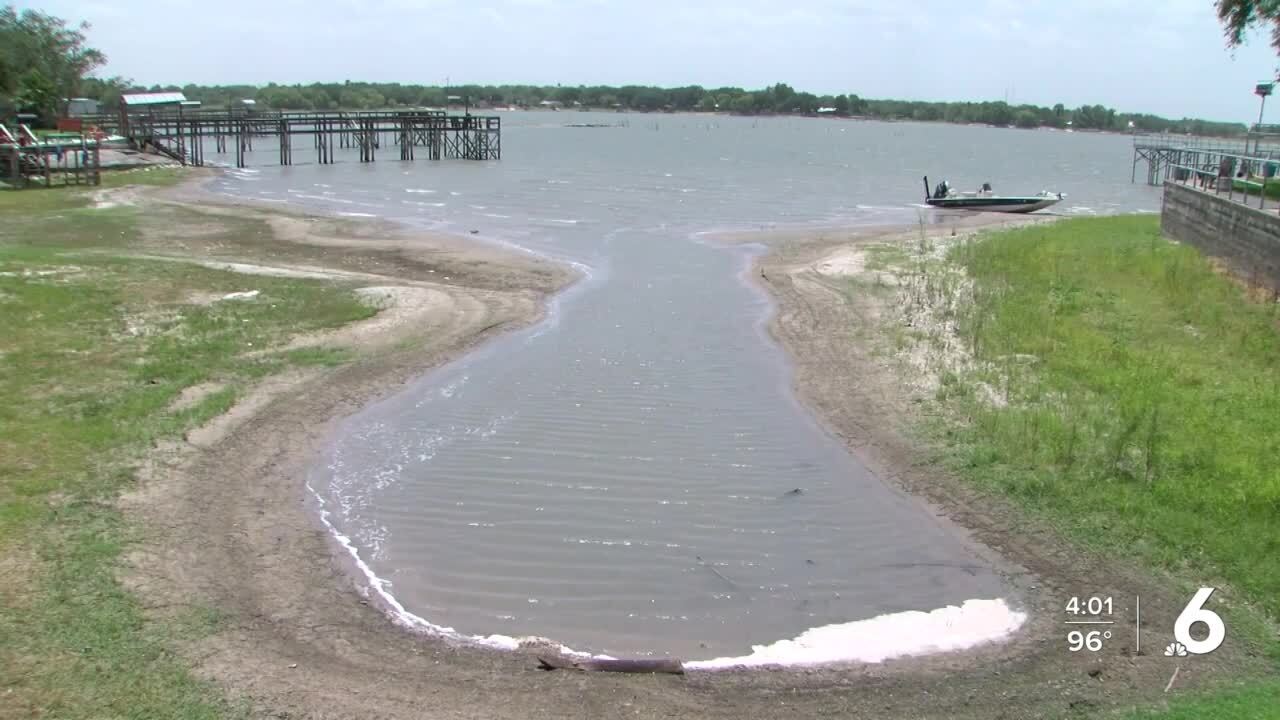
Lake Texana is now struggling under the same drought gripping the region.
"Lake Texana now also is, I would say, in trouble," Zanoni said. "I don't think anybody saw this coming, even the operators of Lake Texana."
He said the lake is currently at 55% capacity and that the Lavaca-Navidad River Authority could impose a 10% reduction in purchases as early as April, with a possible second reduction later this summer. Some of the city's six new water models now factor in those cuts.
If a Level 1 emergency is declared
Zanoni said Friday the city will not force compliance if a Level 1 water emergency requiring a 25% citywide reduction in water use is declared.
"We're not gonna go around turning people's valves off on their homes or commercial businesses or the industry," Zanoni said. "It's gonna be self-regulated and it's gonna have to be a community lift."
He said large industrial customers on the ship channel — accounting for roughly 55-60% of daily water consumption — are already meeting with the city weekly to discuss reductions.
He also defended the scope of work underway and pushing back on what he described as an inaccurate public message this week.
"We have brought forth projects totaling a billion dollars that will generate 76 million gallons of water — new water supply, the first new water supply in decades for this city," he said. "Everything that we can possibly do, we're doing."
He acknowledged the final steps on several projects are outside the city's control.
"The only missing part in a few of those projects is permits — permits that we don't control, permits that the state controls, or groundwater conservation districts," Zanoni said. "I can't pull a manual from the last time this happened. Nobody's been through this. Nobody."
Six water supply models — ranging from best case to worst case — will be presented to the City Council Tuesday.