


CORPUS CHRISTI, Texas — State environmental regulators will consider Wednesday whether to uphold, change or throw out an emergency order that allows Corpus Christi to hold water in its reservoirs instead of releasing it downstream to the bay.
The Texas Commission on Environmental Quality is scheduled to take up the matter at 9:30 a.m. Wednesday. It is the first item on the agenda.
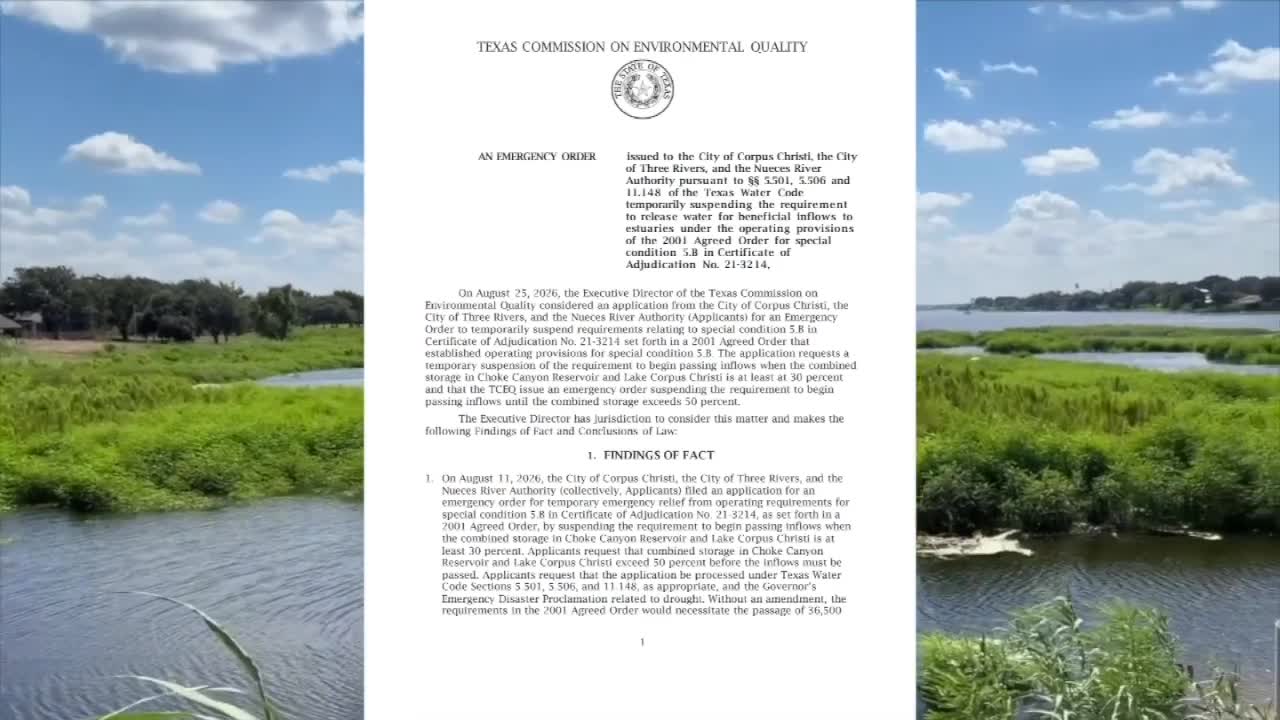
The emergency order, signed Aug. 25 by TCEQ Executive Director Kelly Keel, temporarily suspends pass-through requirements under a 2001 agreement between the City of Corpus Christi, the City of Three Rivers, the Nueces River Authority and the state. That agreement requires the city to release a portion of water flowing into its reservoir system, Lake Corpus Christi and Choke Canyon Reservoir, downstream into the Nueces Estuary to support the health of Nueces and Corpus Christi bays.
The order was issued without a hearing. Wednesday's meeting is the commission's first opportunity to weigh in.
Under the 2001 agreement, the amount of water that must pass through the system depends on how full the reservoirs are.
As KRIS 6 Chief Meteorologist Stefanie Lauber has reported, the pass-through targets work on a sliding scale: when combined capacity is at or above 70%, the annual target is 138,000 acre-feet — roughly 64,000 Olympic swimming pools' worth of water. Between 40% and 70%, the target drops to 97,000 acre-feet. Between 30% and 40%, the target is 14,400 acre-feet. Below 30%, releases are suspended entirely.
The emergency order changes the math. It raises the threshold at which releases are suspended from 30% to 50%. That means as long as combined storage remains below half full, no water has to be released.
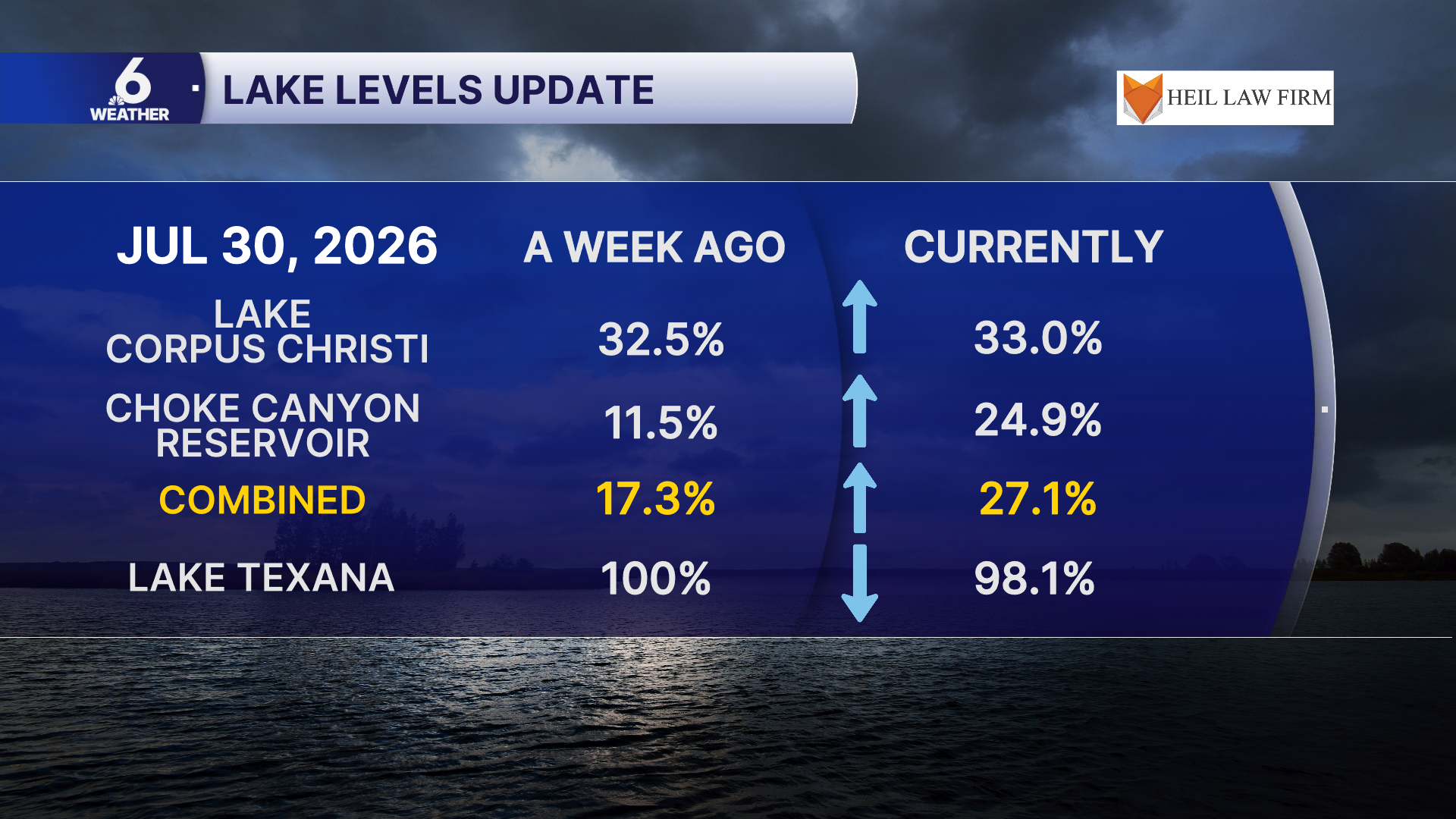
As of Sept. 7, combined storage stood at just over 41% — above the old 30% trigger but below the new 50% threshold. Without the emergency order, the TCEQ estimates approximately 36,500 acre-feet of water — enough to fill roughly 17,000 Olympic swimming pools — would need to be released over the next 120 days if storage remained above 40%.
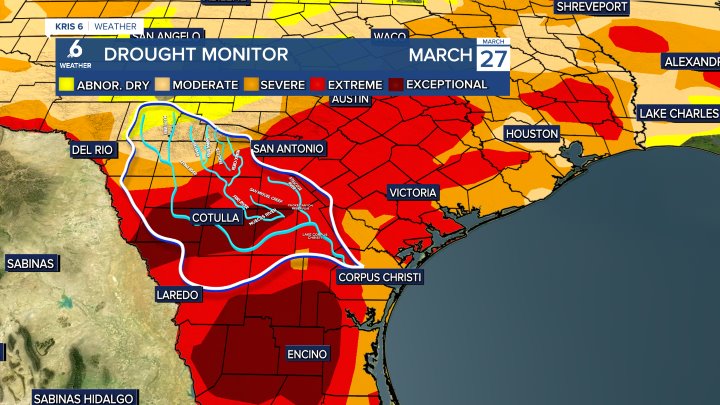
The Nueces River basin has been in a prolonged drought. The TCEQ described current conditions as "likely worse than those experienced during the drought of record" from 2007 to 2013, when the lowest combined storage reached 33%.
This time, combined storage fell to an all-time low of 7.7% in May 2026, according to the TCEQ emergency order.
As KRIS 6 News has reported, heavy rainfall in July brought a dramatic turnaround. Choke Canyon Reservoir reached its highest water levels in over a year. Lake Corpus Christi rebounded to roughly 91% capacity by late August.
The City of Corpus Christi, the City of Three Rivers and the Nueces River Authority filed the application on Aug. 11 under the governor's drought disaster proclamation for Coastal Bend counties.
According to the emergency order, the TCEQ found there are no feasible short-term alternatives. Water from the Evangeline Groundwater Program is not expected until February 2027. Brackish groundwater treatment is on a similar timeline. The city's reclaimed water project does not have the capacity to address emergency conditions.
Formally amending the 2001 agreement is also not a near-term option. The order states that process would require coordination with the Nueces Estuary Advisory Council, a basin-wide 30-day notice and an opportunity for a hearing.
The order also states there has been no evidence of fish kills or marine life depopulation "directly attributable" to the absence of pass-through releases. Pass-throughs had been suspended for 19 months before recent rainfall because combined storage was below 30%, according to the TCEQ order.
Texas Parks and Wildlife Department submitted comments on the application but did not take a position, according to the order.
The emergency order is in effect through Dec. 23. If combined storage is still below 50% on that date, the order automatically renews for 60 additional days through Feb. 21, 2027.
If the TCEQ commission affirms the order Wednesday, it remains in place as written. Commissioners could also modify or set it aside. Public comments are due by 5 p.m. Sept. 7.
This story was reported on-air by a journalist and has been converted to this platform with the assistance of AI. Our editorial team verifies all reporting on all platforms for fairness and accuracy.