

CORPUS CHRISTI — The Texas Commission on Environmental Quality has approved an emergency order allowing Corpus Christi's reservoir system to retain water that would otherwise be released downstream to support bay and estuary health.
The city said it sought the temporary suspension "as part of its continued efforts to manage available water supplies during ongoing drought conditions while advancing projects to strengthen and diversify the region's long-term water supply."
The order, signed Aug. 25 by TCEQ Executive Director Kelly Keel, suspends pass-through requirements under a 2001 agreement that governs how much water must be released from Lake Corpus Christi and Choke Canyon Reservoir into Nueces Bay and the Nueces Delta.
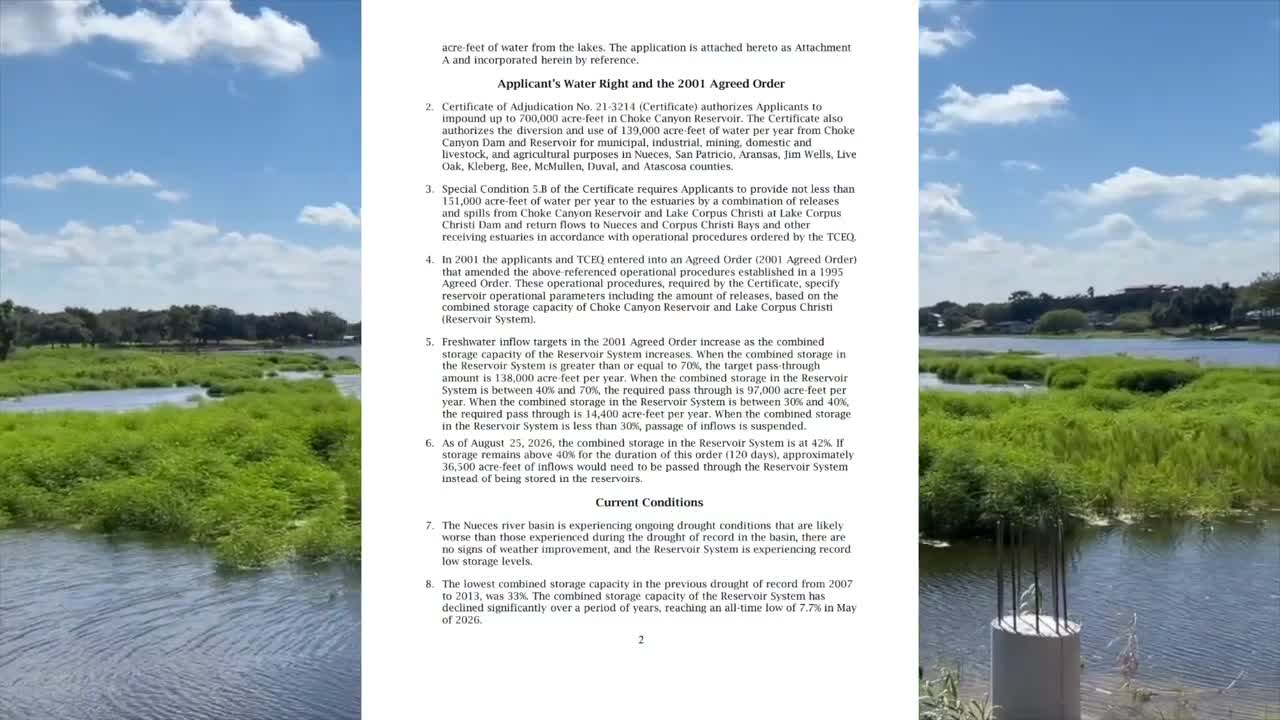
Under the existing agreement, the reservoir system must begin releasing water when combined storage reaches 30%. The emergency order raises that threshold to 50%, meaning inflows can be stored rather than passed downstream.
Combined storage stood at 42% as of Aug. 25, according to the TCEQ order. Without the suspension, the order states approximately 36,500 acre-feet of inflows would need to pass through the system over the next 120 days if storage remained above 40%.
How the pass-through system works
The pass-through requirement originated in a 1995 agreement between the city, the Nueces River Authority, the City of Three Rivers and the state. It was amended in 2001. The agreement requires a portion of water flowing into the reservoir system to continue downstream to support the health of Nueces and Corpus Christi bays and other receiving estuaries.
The amount varies based on how full the reservoirs are. According to the TCEQ order, the required annual pass-through amounts are:
When combined storage is at or above 70%, the target is 138,000 acre-feet per year. Between 40% and 70%, the target drops to 97,000 acre-feet. Between 30% and 40%, it is 14,400 acre-feet. Below 30%, releases are suspended entirely.
Because combined storage had been below 30% for 19 months before recent rainfall, no water had been released from the reservoir system to support freshwater inflows during that period, according to the TCEQ's findings.
The order states there has been no evidence of fish kills, marine life depopulation or environmental complaints about bay impairment "directly attributable" to the absence of those releases.
KRIS 6 News reported in June that State Rep. Denise Villalobos sent a joint letter to the three certificate holders calling for the 2001 agreement to be amended or vacated. At that time, all three parties had agreed to pursue modifying the 30% trigger to 50%.
Why the TCEQ says this is an emergency
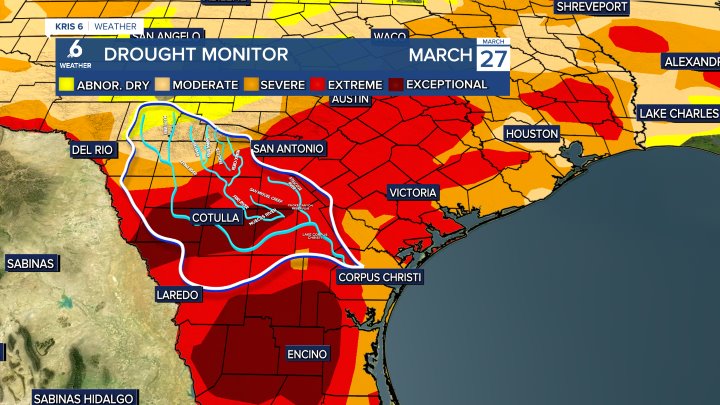
The TCEQ's findings describe the Nueces River basin as experiencing drought conditions "likely worse than those experienced during the drought of record" in the basin, which ran from 2007 to 2013. During that drought, the lowest combined storage reached 33%.
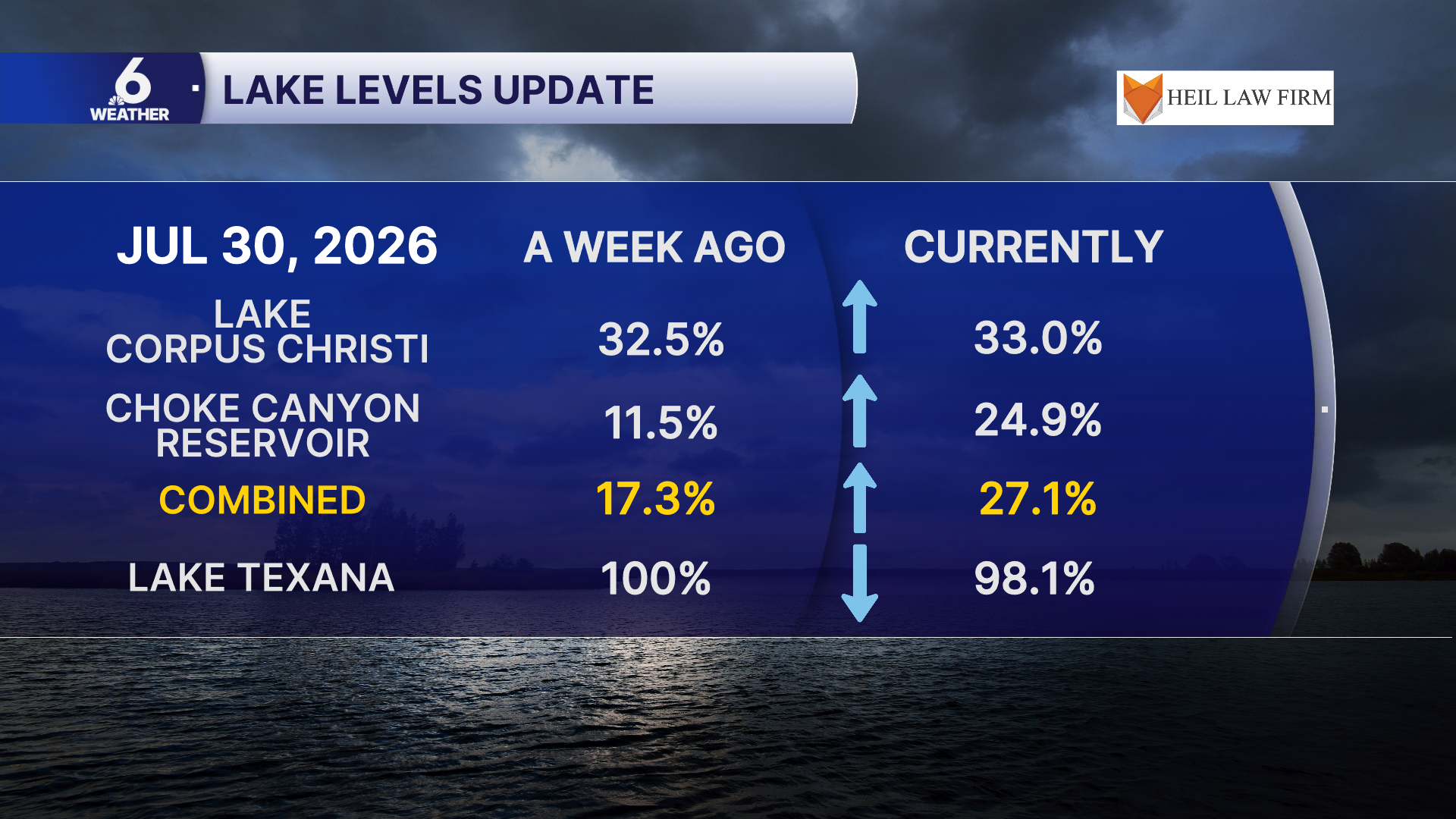
This time, combined storage fell to an all-time low of 7.7% in May 2026, according to the order.
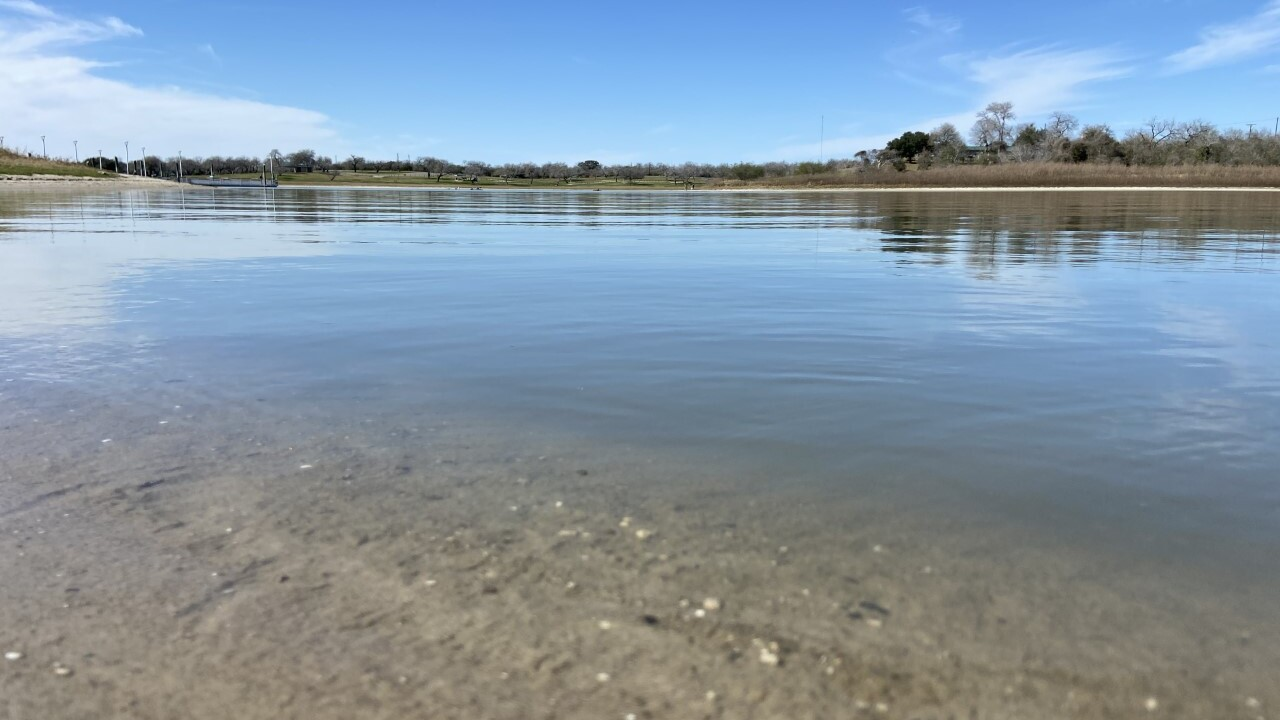
Recent rainfall boosted Lake Corpus Christi to 91% capacity, but Choke Canyon Reservoir, the larger of the two, remained at just 24% as of Aug. 25.
The TCEQ cited Aug. 3 National Weather Service forecasts indicating the region is expected to be hotter and drier than normal for the next several months, with no relief from drought conditions anticipated until winter.
The order notes that, as of Aug. 4, Corpus Christi's regional water system had spent 596 days under the most severe stage of the city's drought contingency plan. The city moved to Stage 2 restrictions in early August after reservoir levels rose. It is currently in Stage 2, which includes mandatory limits on lawn irrigation, restrictions on car washing and nonessential water use, and enforcement measures.
The TCEQ found that the 2001 agreement "did not consider the low inflows and storage conditions that the Reservoir System is currently experiencing."
No short-term alternatives available, TCEQ finds
The TCEQ found there are no feasible, practicable alternatives to the emergency order. The order lists several projects the city is pursuing, but states that none can provide relief in the near term.
Water from the Evangeline Groundwater Program is not expected to be delivered until February 2027, according to the order. Brackish groundwater treatment is on a similar timeline. The city's reclaimed water project could reduce non-potable demand but does not have the capacity, operational reliability or timing to address emergency conditions.
The Mary Rhodes pipeline is undergoing repairs to expand capacity, but the order states expanded capacity increases resilience and does not create an additional water supply.
Formally amending the 2001 agreement is also not a near-term option. The order states that process would require coordination with the Nueces Estuary Advisory Council, a basin-wide 30-day notice and an opportunity for a hearing.
What happens next
The emergency order took effect immediately and lasts 120 days, through Dec. 23, 2026. If combined storage remains below 50% on that date, the order automatically renews for 60 additional days through Feb. 21, 2027.
The TCEQ Commission is scheduled to hold a hearing on Sept. 9, 2026, at 9:30 a.m. at its Austin headquarters to consider whether to affirm, modify or set aside the order. The order was issued without a hearing by the executive director.
The city, Nueces River Authority and City of Three Rivers filed the application on Aug. 11. It was processed under the governor's drought disaster proclamation for Coastal Bend counties, first issued July 8, 2022 and most recently renewed July 16, 2026.
Texas Parks and Wildlife Department submitted comments on the application but did not take a position, according to the order.
In a statement, the city said it "thanks our entire state delegation and partners in Austin for their support and advocacy in advancing this request."