

CORPUS CHRISTI, Tx — Gov. Greg Abbott's office told KRIS 6 News the governor has directed state agencies to take immediate action to protect Corpus Christi's water supply, waiving regulations to speed up permitting and ordering a key river authority to prevent near-term water cuts to the city.
Abbott waived regulations allowing the Texas Commission on Environmental Quality to issue temporary water permits on an expedited basis and directed the Lavaca-Navidad River Authority (LNRA) to prevent curtailments to Corpus Christi's water supply.
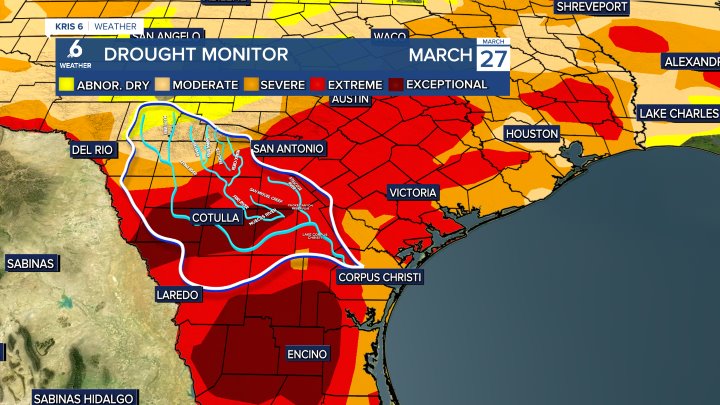
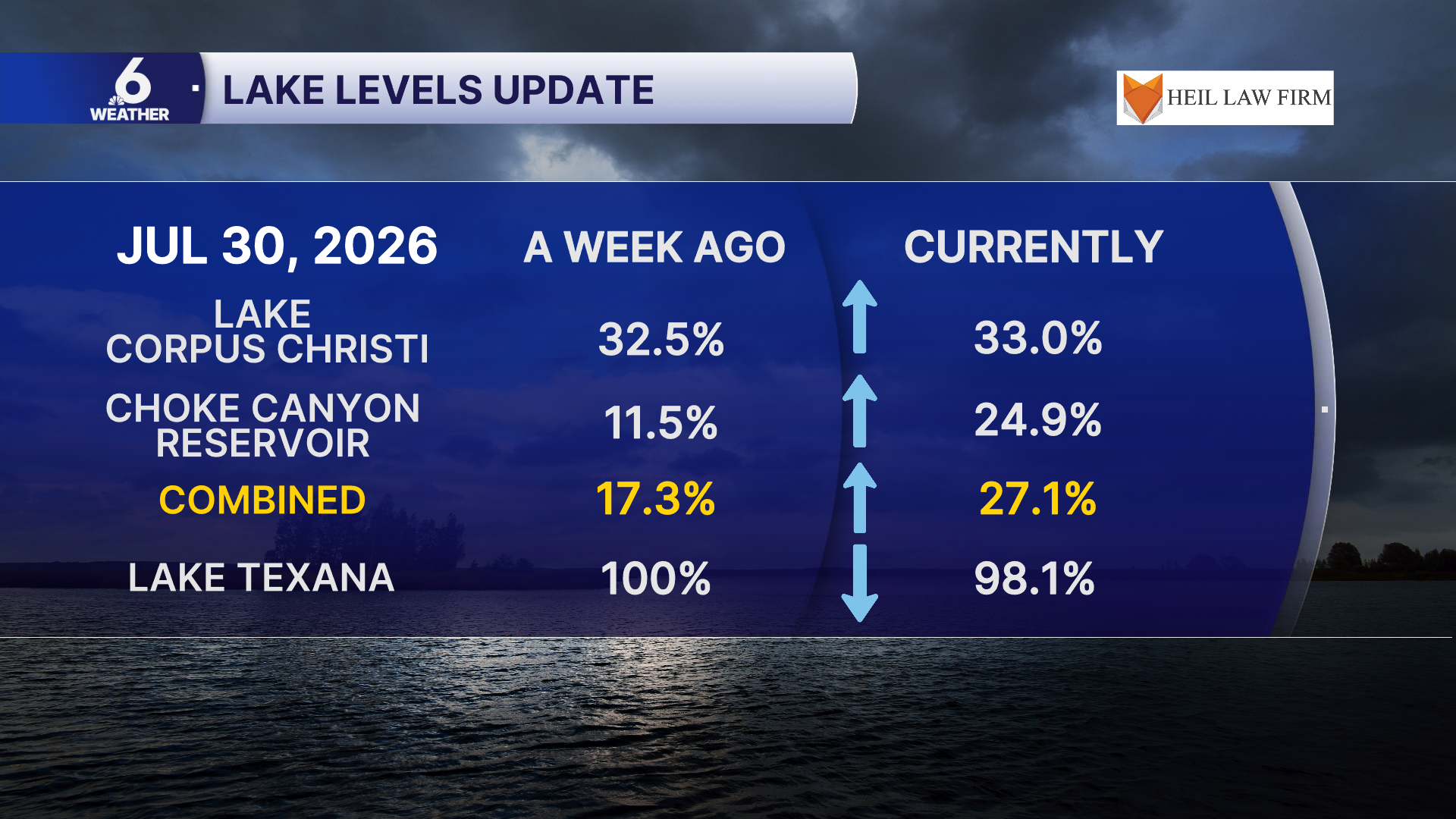
The City of Corpus Christi is seeking state permits to unlock groundwater from well fields — water the city urgently needs as its reservoirs sit at just 9.5% capacity. Without those permits approved, the city cannot replace what its failing reservoirs no longer provide.
The order to the LNRA is significant because the authority had been expected to curtail — or cut — water deliveries to Corpus Christi, a move that would have further reduced the city's already strained supply.
The governor's press secretary said in a statement that Corpus Christi is "an important economic driver not only for Texas but also for the nation," and that the state is "committing significant investments" to ensure the city has the water resources it needs.
Corpus Christi is an important economic driver not only for Texas but also the nation. The State of Texas is committing significant investments to ensure Corpus Christi has the water resources it needs to serve citizens. The Governor is further stepping in and has waived regulations to ensure TCEQ can issue temporary permits on an expedited basis - while still preserving public input - and directed the LNRA to ensure Corpus Christi water is not curtailed in the near term to further protect residents as the city forms long-term solutions. Governor Abbott will utilize all necessary tools to ensure the Corpus Christi area has a safe, reliable water supply.
Context: What Abbott said last week
The moves come one week after Abbott publicly addressed the crisis — pledging full state commitment while also warning of possible intervention.
Speaking at a campaign stop in Manor, near Austin, Abbott said the state had been "actively involved" in Corpus Christi's water situation "going back a long time." He said the state provided the city with $750 million to address the problem, then added: "You know what they did? They squandered it and then they changed their plan and then they were indecisive about what to do."
Abbott warned that time was running short for local leaders: "We can only give them a little time more before the state of Texas has to take over and micromanage that city and run that city to make sure that every resident who goes to the water tap and turns it on, they're going to be getting water out of their faucet — not because of what local leaders are doing, but because of what the state of Texas will do."
In the same remarks, Abbott pledged the state's commitment to residents regardless of the outcome. "We're fully committed to making sure the Corpus Christi residents are going to have the water they need to live their lives like the rest of the people in the state of Texas," he said.
City Manager Peter Zanoni responded at the time, saying the city was "deeply grateful for prior and continued support from Governor Abbott and his Office."
What the state has committed:
- $20 billion statewide: Abbott signed legislation last session described as the largest water investment in Texas history, funding new water supplies and repair of aging infrastructure across Texas.
- $757 million for Inner Harbor desalination: The Texas Water Development Board has committed this amount to fund a marine desalination plant — a project the governor's office called a priority for securing a "durable long-term water source." However, the figure refers to loan commitments through the State Water Implementation Fund for Texas, not grants, and most of it has not been released. It remains locked unless the city proceeds with a TWDB-eligible desalination project. Only approximately $235 million has been issued to the city in bonds — money the city owes regardless of what happens to the desalination project.
- $30 million for groundwater wells: State budget funding designated for new groundwater wells in the Corpus Christi area.
- $16 million for the Mary Rhodes Pipeline: Designated to upgrade the pipeline that carries water from Lake Texana to the city.
Why the wells matter
With reservoirs at 9.5% combined capacity and no signs of recovery, groundwater wells are the centerpiece of Corpus Christi's near-term water strategy. The city must replace 50 million gallons per day — and wells are expected to supply 40 of it. But each component of that plan has faced obstacles.
The Eastern Well Field is running at 4 million gallons per day — less than half its permitted capacity of 10 million gallons per day. The reason, Zanoni confirmed, is water quality: "Because of the management plan that we have for water quality on salt, on TDS, we're not able to put 10 million in, and we haven't been for the past couple of months." The city has applied to TCEQ for an emergency order to unlock the remaining 6 million gallons per day.
The Western Well Field is projected at 17 million gallons per day, but requires a TCEQ bed and banks permit that faces objections from multiple parties. The Ed Rachal Foundation's adjacent 9 million gallons per day is tied to the same permit — both stall together if it is delayed.
The Evangeline Groundwater Project in San Patricio County is projected to add just 5 million gallons per day in 2026, with the bulk of its capacity not arriving until 2027. Its permits are already in a legal hearing after the City of Sinton and St. Paul Water Supply Corporation filed formal protests.
TDS — total dissolved solids, a measure of salt and mineral content — has limited how much the city can actually pump. The federal drinking water standard is 500 TDS. Residents near well outflows along the Nueces River have recorded readings as high as 3,300.
Downstream, Nueces County Water Control and Improvement District No. 3, which supplies Robstown and roughly 10,000 customers, reported TDS at its treatment plant had more than doubled — from a 15-year average of 700 to roughly 1,500.
Chris Cuellar, who is organizing the first resident-led groundwater conservation district in Nueces County, said groundwater will never truly be temporary for the city. "Unfortunately, it's the cheapest water, the easiest to obtain — and it'll always be the go-to when they sell another contract to industry."