

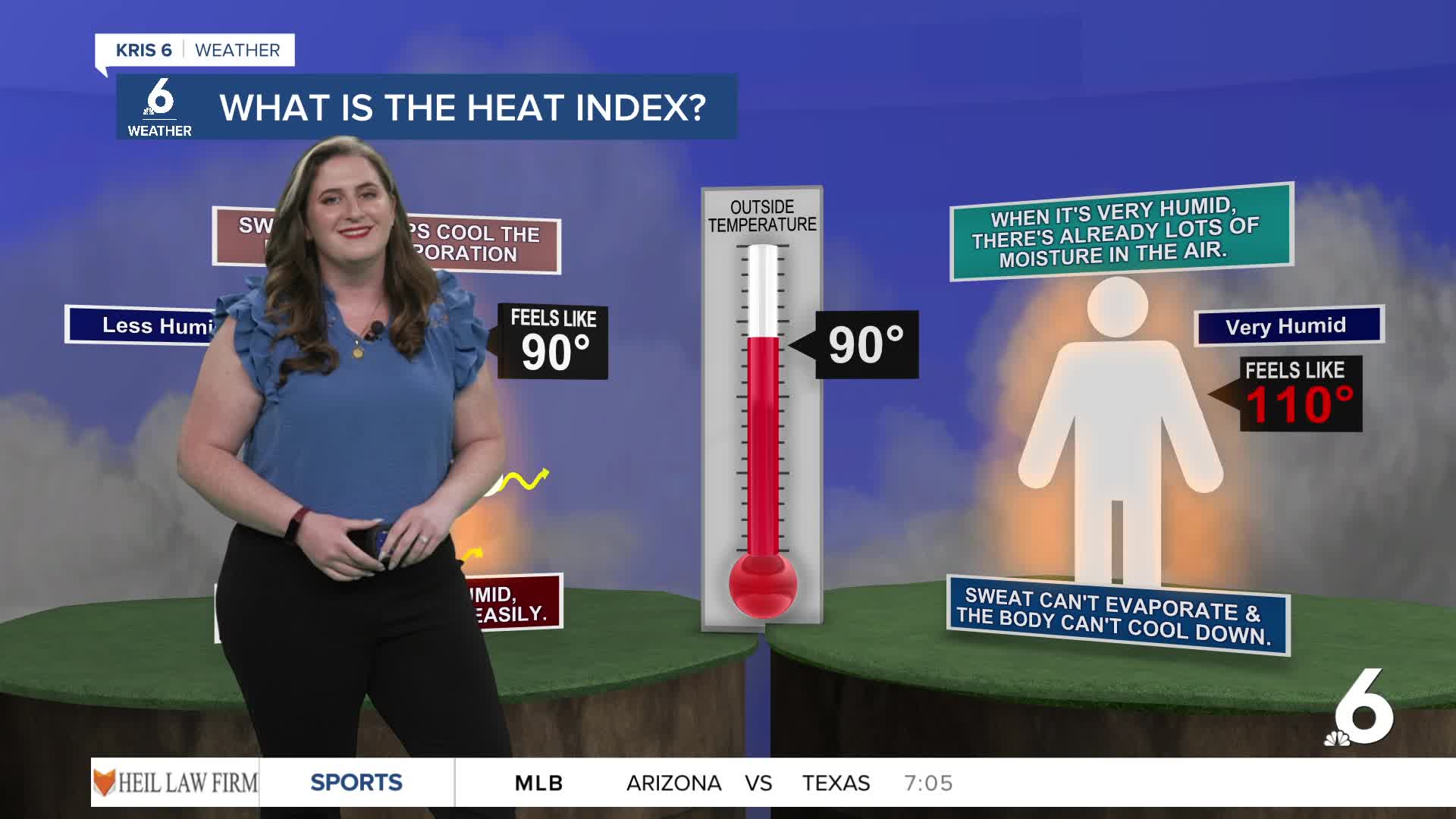


CORPUS CHRISTI, Texas — As summer-like heat creeps into the seven-day forecast, you're neighborhood weather experts will be talking more frequently about the 'feels like' temp, or the heat index.
What is the heat index?
The heat index is a calculated number meteorologists also refer to as 'apparent temperature'. It's the temperature your body perceives given the actual air temperature and the relative humidity.
Heat Index
The Heat Index (HI) or the "Apparent Temperature" is an accurate measure of how hot it really feels when the Relative Humidity (RH) is added to the actual air temperature.
This equation to calculate this number is complicated (multiple regression analysis, anyone?), but suffice to say it's a temperature you should prepare for.
Why do we use 'feels like' temps? Can't we just say that is the temperature?
It might seem convenient, but the science explains why we can't just use the 'feels like' temp in place of the actual air temp. Take for example, the heat index's 'cooler cousin', the wind chill. While your body may perceive a temperature of 29ºF, if the actual air temp is 35º then water won't freeze. In other words, just because our bodies perceive that temperature, it doesn't mean the rest of the physical world feels the same way.
Why does it matter?
The human body cools off by sweating. As your sweat evaporates off your skin and into the atmosphere, there is an exchange— your skin cools and the atmosphere warms. This process works well on dry days, but on very humid days, your sweat doesn't evaporate as easily. This makes it harder for the body to cool off and regulate its temperature. So 90ºF might feel more like 100ºF— and that's in the shade! Yes, the heat index accounts for shady conditions; in direct sunlight, the heat index can easily be 15 degrees higher! For this reason some scientists and public health experts prefer to use another measurement to communicate heat risk, such as the Wet Bulb Globe Temperature or WBGT. The WBGT takes into account many weather factors like solar radiation, relative humidity, wind, and air temperature.
What can I do with this information?
The heat index aims to help us understand the stress the body will undergo when participating in strenuous activity outdoors. Heat can be dangerous! You should practice heat safety when the heat index rises through the 90s. Heat-related illness like heat stroke and heat exhaustion can be avoided if you're prepared!
