

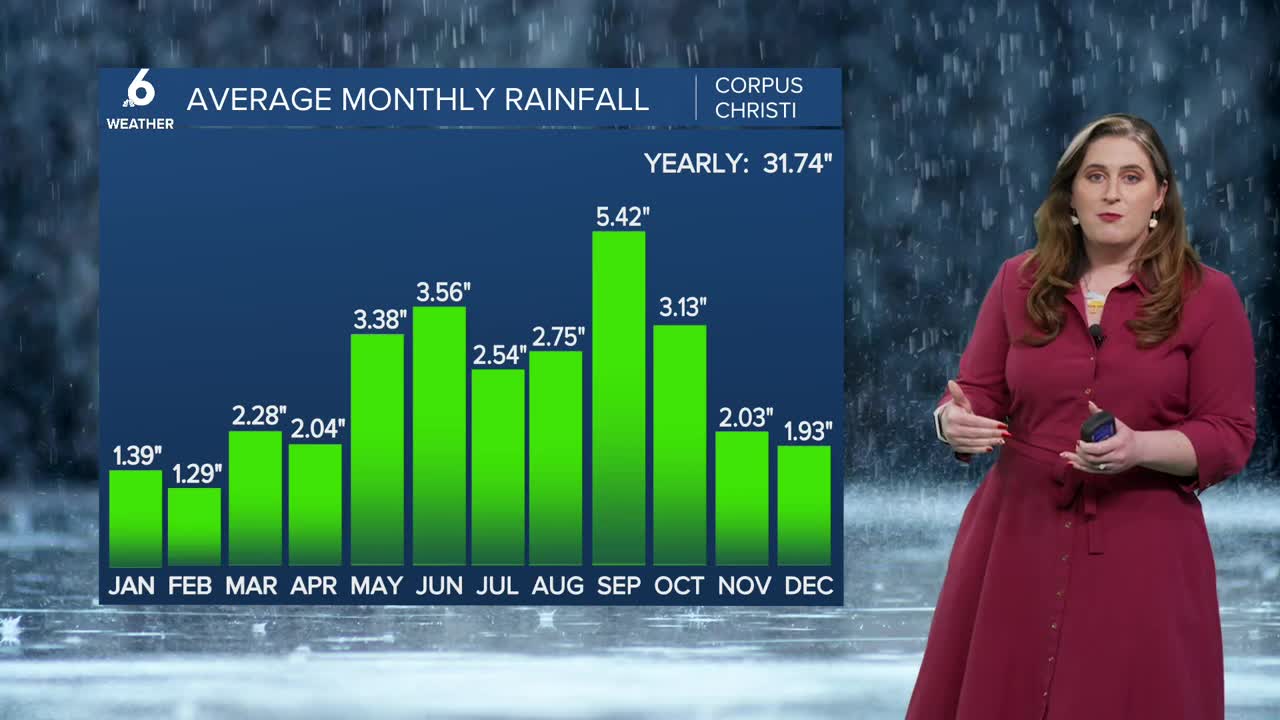


CORPUS CHRISTI, Texas — All eyes are on the Coastal Bend's looming water crisis. We continue to receive discouraging updates about our water supply, but there is uplifting news regarding our long-term rainfall outlook.
WE ARE 'HERE'
Combined capacity at Choke Canyon and Lake Corpus Christi fell to just 9.5 percent this week. According to the City of Corpus Christi, this puts the area on track to reach a Level 1 Water Emergency by November 2026. This is the lowest water supply in the history of our western reservoirs.
HOW WE GOT 'HERE'
When it comes to predicting a drought, there are two key factors: rainfall and temperatures. The National Weather Service defines drought simply:
Drought is a deficiency in precipitation over an extended period. It is a normal, recurrent feature of climate that occurs in virtually all climate zones.
Specifically, the Coastal Bend has had less rainfall than expected for much of the past five years. This has been worse by temperatures that have been warmer than expected during the same time period. While the lack of rainfall has pushed our water supply to historic lows, hotter temperatures have aided in the evaporation of that already dwindling supply.
We are currently in the dry season of our rainfall climatology. In fact, Corpus Christi's driest month is usually February, with January taking second place. Even so, just two weeks into the driest month, Corpus Christi International Airport has still recorded less rain than what is expected up to now. And while the year ahead looks to be a continuation of a years-long drought, there's hope on the horizon.
John Metz, the Meteorologist In Charge of the National Weather Service Corpus Christi (NWS Corpus Christi) says while 2021 was our third wettest year in Corpus Christi, it was one of the driest for our watershed which sits about 100 miles to the northwest.
Metz explains that our reservoirs last filled from rainfall in 2007, and have steadily declined ever since. He attributes the drought of 2011 (the worst in state history) to much of the water lost and explains that while a few wet years help lake levels go up, it wasn't enough.
EL NIÑO IS EXPECTED LATER THIS YEAR
The El Niño Southern Oscillation (ENSO) is a teleconnection or climate pattern that tends to bring wetter weather to the Coastal Bend. The keyword: 'tends'; it's not always the case. The strength of the El Niño also influences whether the Coastal Bend experiences more rainfall than usual. Metz agrees there isn't a strong correlation, but it would be good timing for such a pattern to settle in during out wetter months.
WHERE TO LOOK
Metz says a good 'pinpoint' for conditions within our watershed is Cotulla, Texas. He's identified a rainfall trend within that area that suggests we may end the dry spell soon. When Cotulla experiences a recurrence of about 10 inches of rainfall per 30 days, we tend to see a positive impact at our reservoirs. He's says that trend happens every 5-10 years and it's about that time... Our drought has been in the making for 19 years and there's hope that the pattern will turn in our favor.
The science of meteorology can't yet predict when the drought will end, but there are signals in our climatology that lend hope it might get better soon.
