

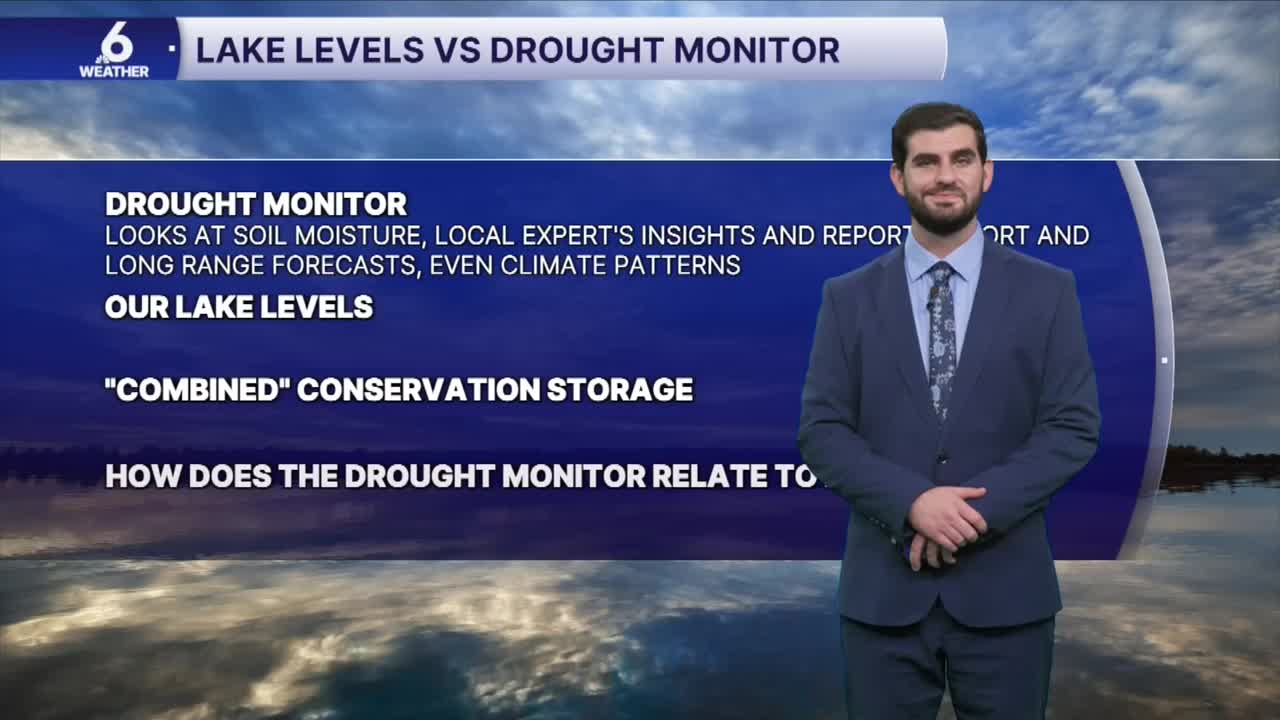


CORPUS CHRISTI, TX — Over the past year, we’ve discussed the drought monitor and lake levels time and time again, and both are incredibly important when determining future concerns for water levels across South Texas.
Drought Monitor and South Texas
The drought monitor depicts the severity of drought in any given area by combining multiple factors to classify conditions anywhere from no drought to a D4 drought. D0 is considered “Abnormally Dry,” D1 is a “Moderate Drought,” D2 is a “Severe Drought,” D3 is an “Extreme Drought,” and D4 is the highest level: “Exceptional Drought,” when soils are extremely dry and the region has received far below normal rainfall.

The map is first created using rainfall data, but it also takes into account condition observations, reports, and insight from local experts on subjects such as soil conditions and climate weather patterns that could play a role in future conditions. All this to say it’s not just a computer assigning colors randomly to the map based on only a radar estimated rainfall. Scientists evaluate all of these other factors as well before releasing the final drought monitor every Thursday morning for public use.
Lake Levels and Our Current Situation
Another important topic when discussing our water supply is the status of lakes and reservoirs across South Texas. This is slightly simpler than the drought monitor, which considers multiple factors. Reservoir levels focus on how much water is currently stored compared to the reservoir’s total capacity. For example, if “Lake Steven” could hold 100,000 gallons of water and currently contained 50,000 gallons, it would be at 50% of total reservoir storage capacity.
Currently our reservoirs are sitting well above where they were six months ago as we head into the middle of September. Lake Corpus Christi is at 87.4%, Choke Canyon Reservoir is at 22.9%, and Lake Texana is at 86.9%. When discussing “combined capacity,” we’re referring to the combined storage of Lake Corpus Christi and Choke Canyon Reservoir. Six months ago, that combined capacity was down to just 8.7%. After the early summer rains, it climbed to around 43.2%, though levels are now slowly falling again due to the lack of recent rainfall and sitting at 40.9%.

Which Is More Important When Discussing Our Water?
Both are equally important when discussing our overall water situation. The biggest overlap between the two is that the drought monitor directly influences lake levels and their near future, while lake levels themselves have less influence on the drought monitor. When an area is in drought or even abnormally dry conditions, it becomes harder for rainfall to make its way into lakes and reservoirs because dry soils absorb much of the water before it can reach them.
Across the Coastal Bend, the entire region is now back in drought status, ranging from Moderate to Severe Drought (D1 to D2), due to the lack of recent rainfall. While lake levels are in much better shape than they were six months ago, they are slowly falling once again. Any rainfall that does occur will also have a harder time reaching reservoirs because of the ongoing drought conditions.
All this means that until the drought conditions once again improve across South Texas and our Nueces River watershed, lake levels will continue to slowly decline in the near future. While it's good to have water in the reservoirs and lakes, it's even better to have a lack of drought to allow those same reservoirs to remain filled instead of evaporating off and being absorbed into the surrounding soils and vegetation.
