


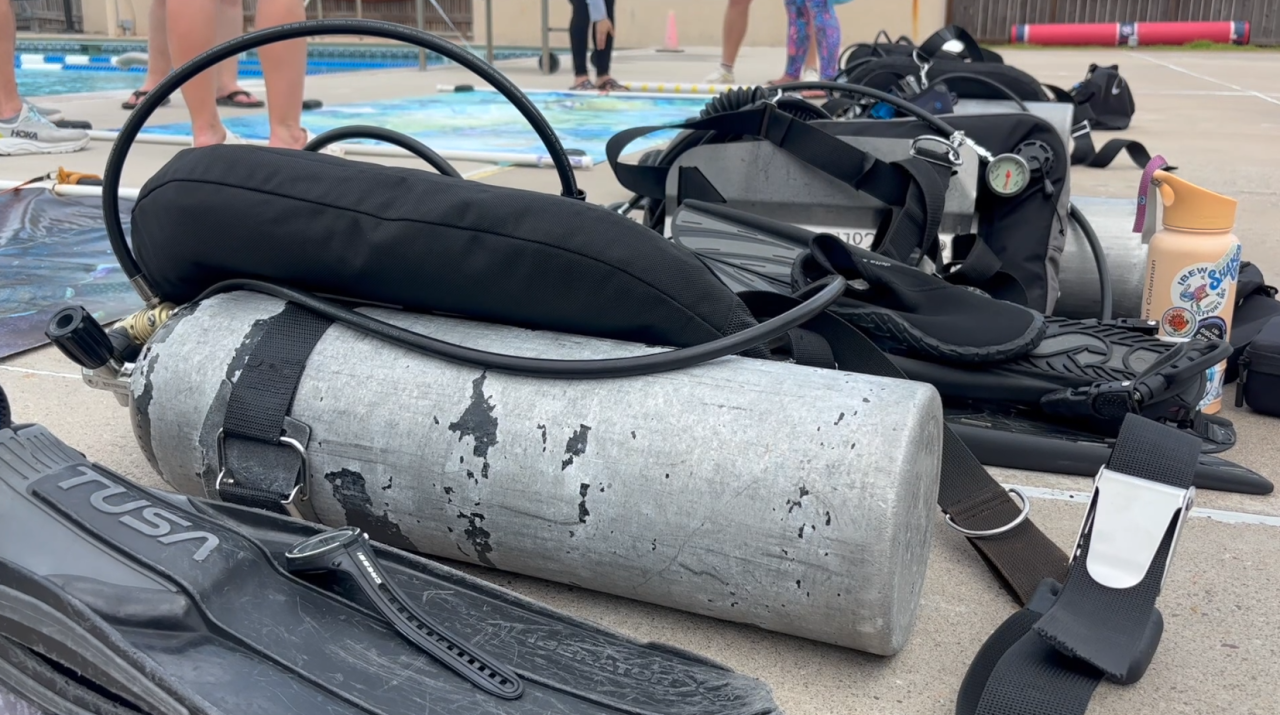
CORPUS CHRISTI, Texas — Student scientific divers at Texas A&M University-Corpus Christi trained on a life-size replica of the Flower Garden Banks National Marine Sanctuary lining the bottom of the university's swimming pool on Friday, April 17.
During the training session, students practiced navigating the reef, measuring corals and documenting marine life to prepare for future expeditions. The students also learned National Oceanic and Atmospheric Administration national standards for monitoring coral reefs.
"This is a unique hands-on opportunity to get in the water and learn what it takes to be a marine biologist," Dr. Keisha Bahr said.
Bahr is the Chair for Coral Reef and Ocean Health at the Harte Research Institute at TAMU-CC.
"Students gain an immersive underwater experience where they learn how to measure and document corals — building the skills they'll need for future careers in marine science," Bahr said.
The training uses life-size mats that replicate actual corals found at the Flower Garden Banks National Marine Sanctuary, located about 100 miles offshore from the Texas coast.
"A lot of people think that because we're on the water that we would have more of these coral reefs," Bahr said.
"Actually here in Corpus we have these smaller corals that don't actually form coral reefs, but the coral reefs that we're studying right now, they're about 100 miles offshore, so they are still Texas coral reefs, and a lot of people don't know about them, and they are some of the healthiest reefs that we have especially on this side of the world," Bahr said.
The pool-based simulation allows students to practice in a controlled environment before venturing into offshore conditions.
"It's pretty amazing to be able to have life-size images of this so that we can bring the reefs to the students we can put it in the pool and they can practice safely these different techniques in a really controlled environment," Bahr said.
Students learn to identify coral species and measure their width, length and height to assess colony health. This data collection follows the same protocols used by government agencies like NOAA.
"We're using the techniques that are used by our government that are the NOAA standards, and we're training our students to be able to do those NOAA standards so that they can quantify these beautiful coral reefs that we have," Bahr said.
The research serves both scientific and conservation purposes.
"If we don't understand how things change through time, it's hard to know if our actions or what we're doing in terms of governing these areas are changing or responding to that," Bahr said.
"We need to have this long-term record of how corals change over time so that we can make really smart decisions about how to protect them for better future generations," Bahr said.

Larry Lloyd, the university's dive safety officer, emphasized the importance of safety in the program.
"Their first mission, their first job is always to bring everyone back safe," Lloyd said.
The training prepares students for the challenging conditions they will face in the field.
"We often do things that exceed recreational diving. We face strong currents, sometimes there's jellies in the water, you know, low visibility, cold water. It can be very stressful," Lloyd said.
"Safety really goes to training. We're pretty tough on our divers when we train them because we want them to be prepared for the ocean. The ocean is unforgiving when water moves it takes everything with it," Lloyd said.
Students learn to dive to depths of about 130 feet, with the Flower Garden Banks corals typically found between 70 to 90 feet below the surface. All divers must follow a buddy system for safety, and weather or dangerous conditions always take precedence over data collection.
"One of the most important things about the training that we can provide here in a safe environment is we're giving them the real world experience of what to expect once they go into the field," Bahr said.
"This is a really active, immersive way to train students so they have like the hands on experience to see hey I love doing this or you know that's not really for me and it's better to know now so that we can help direct them into a different direction where they'll thrive," Bahr said.
"Our goal really is to train them for exactly what they would do as part of a real job... we use these exact training techniques and so we don't want to do a mock up where you learn kind of some of it. We want you to be able to do exactly what you need to do to be prepared for this job and for the next job," Lloyd said.
Despite being 100 miles offshore, these coral ecosystems have significant local and global importance.
"About 25% of all marine life live on corals at some time in their life," Bahr said.
"A lot of the things that we eat from the ocean come from corals... we also find a lot of our medicines also from coral reefs," Bahr said.
"We have beautiful coral reefs just 100 miles off our coast here, and we're able to protect these and understand those and also train our local students to understand them so we have them for future generations," Bahr said.
For the latest local news updates, click here, or download the KRIS 6 News App.
Catch all the KRIS 6 News stories and more on our YouTube page. Subscribe today!
