

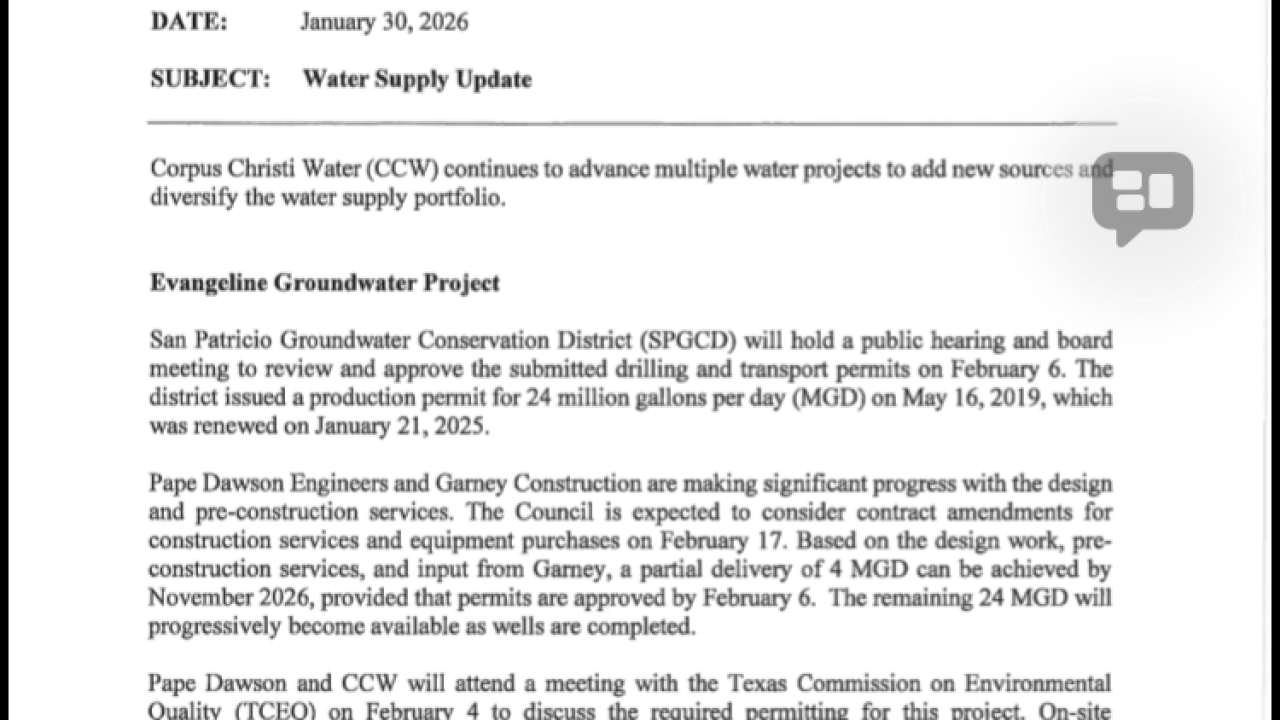


CORPUS CHRISTI, Texas — A recent Corpus Christi city memo written by Corpus Christi Water and adressed to City Manager Peter Zanoni and staff, shows the Evangeline Groundwater Project is expected to produce just 4 million gallons of water per day (MGD) in the near term, far below the 12 MGD figure previously discussed and well short of the roughly 60 MGD city leadership has said is needed to avoid water curtailments this fall.
Evangeline is a proposed groundwater project tied to the Evangeline Aquifer and has been described by city leadership as a major long-term water supply option. City discussions around the project have referenced initial production of 12 MGD, with the potential for eventual expansion to 24 MGD once fully built out.
However, the memo indicates near-term production would be significantly lower, in the range of 4 MGD.
Permitting delays push timeline
Before any drilling or groundwater transport can begin, Evangeline requires final drilling and transport permits from the local Groundwater Conservation District. Those permits are now being formally protested, triggering additional regulatory review and slowing the project’s timeline.
City Manager Peter Zanoni warned earlier this year that delays in permitting could push Evangeline beyond the window needed to help avoid water curtailment.
"If the permits are delayed much beyond Feb. 6, that means the project doesn't start, and then the end date of trying to get water beginning in November won't happen." he said in January.
High costs, limited near-term output
The city will pay $169 million to secure groundwater rights tied to the Evangeline project. City estimates place the total cost of fully developing Evangeline — including wells, pipelines, and treatment infrastructure — at up to $840 million.
Despite that investment, the memo shows Evangeline’s near-term output would amount to less than seven percent of the water city officials say is needed to avoid entering Stage One water curtailment beginning November 1.
Backup wells filling the gap
With Evangeline delayed and desalination projects still years away, Corpus Christi is relying more heavily on existing groundwater supplies:
- Eastern well field: Currently producing about 8 MGD from the Evangeline Aquifer.
- Western well field: Twelve wells are still under construction.
On Tuesday, City Council is expected to consider spending $28 million to expand the Western Well Field onto private land, adding more than a dozen wells as additional measures.
Growing water quality concerns
City officials describe the well expansion as temporary, but increased reliance on groundwater has raised concerns in surrounding areas.
WCID #3, which serves parts of Robstown and San Patricio County, reported total dissolved solids (TDS) levels around 1,500 milligrams per liter, up from historical levels closer to 700 mg/L, raising questions about groundwater impacts and long-term water quality. WCID #3 recently signed an agreement with the City of Corpus Christi for 3 MGD of treated water. With some officials tying that agreement back to the high TDS levels.
What comes next
Even with expanded wells and other near-term measures, Evangeline’s 4 MGD output leaves a significant gap between supply and demand heading into the fall.
City officials continue evaluating reclaimed water projects, additional well expansions, and eventual desalination as part of a broader strategy to close that gap. Decisions made this week — particularly Tuesday’s City Council vote on expanding the Western Well Field — are expected to play a key role in how the city manages water supply while waiting for long-term projects like Evangeline to move forward.
