

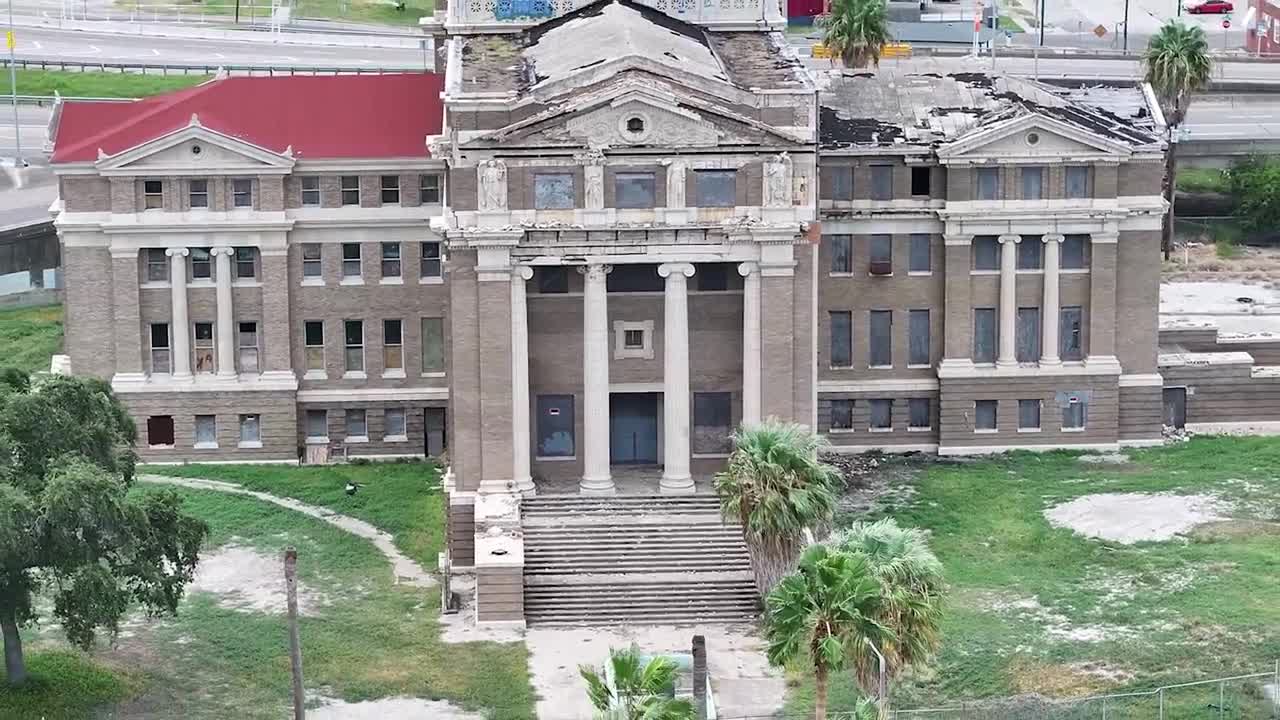


CORPUS CHRISTI, Texas — After nearly five decades of vacancy, failed redevelopment attempts, and layered historic protections, demolition of the 1914 Nueces County Courthouse in Corpus Christi is moving forward.
The Texas Historical Commission signed off on releasing the deed restriction that had blocked demolition, and Nueces County Commissioners Court is set to approve that release.
"The state already signed off. Texas Historical Commission already signed off on the, yeah, we're, we're going to approve the release of the deed restriction that's been held by the Texas Historical Commission… It'll get approved by the full court tomorrow, and then that allows us to move forward with the demolition of the courthouse," County Commissioner Mike Pusley said.
A building shielded by layers of protection
For years, a historic preservation easement held by the Texas Historical Commission, combined with the building's State Antiquities Landmark status and other designations, prevented the county from tearing it down.
When the courthouse was sold in the late 1970s with help from federal acquisition grants tied to Friends of the Courthouse and LexLand Limited, a 40-year preservation deed covenant was granted to the Texas Historical Commission. That covenant, set to expire around May 31, 2018, prohibited demolition and major modifications.
The protection was extended when the county accepted a Texas Historic Courthouse Preservation Program emergency grant in 2001/2002 — roughly $1.2–1.9 million plus matching funds — for limited work, primarily on the south wing. Accepting the grant pushed the easement's protection against demolition out to September 1, 2027.
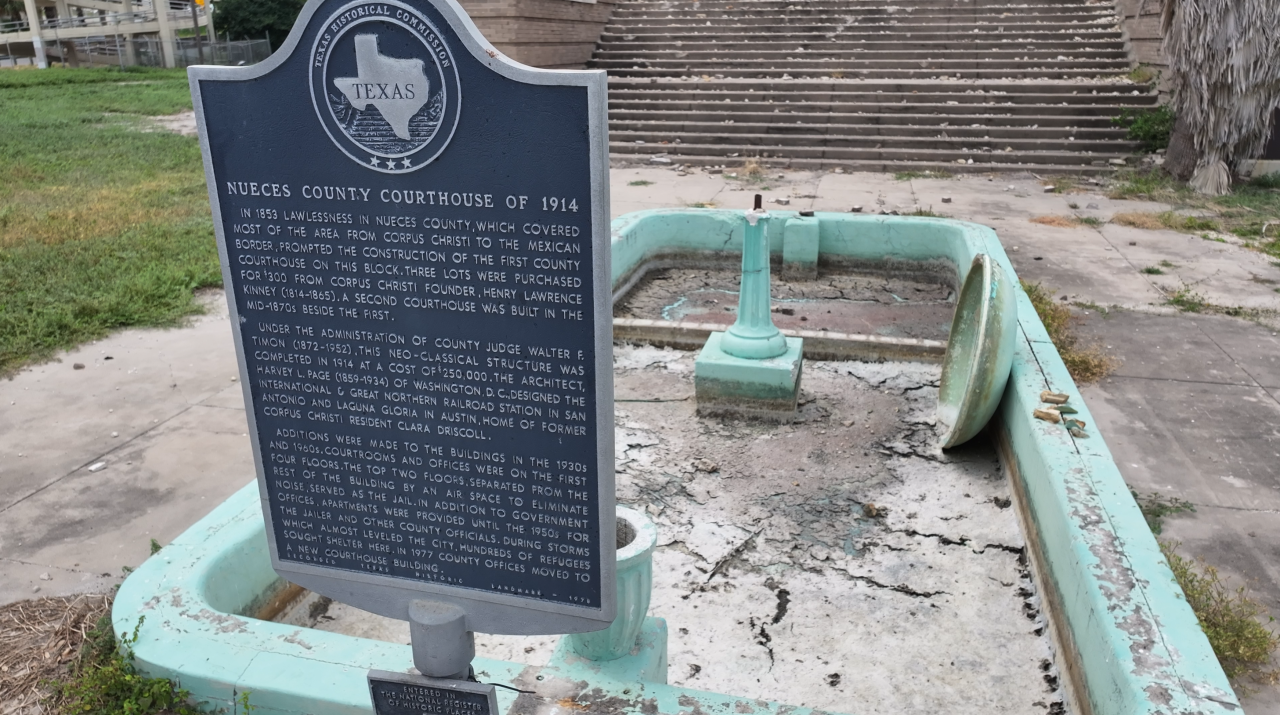
The building also carried National Register of Historic Places listing from 1976, Recorded Texas Historic Landmark status from 1978, and State Antiquities Landmark designation. Those added review and permitting requirements under Texas law, including Government Code provisions on county courthouses and Antiquities Code rules. The Texas Historical Commission had previously indicated it had never terminated such a covenant on a courthouse and was prepared to enforce it, including through litigation if necessary.
Multiple proposals — hotel conversions and other adaptive-reuse plans — collapsed under the weight of renovation costs estimated in the tens of millions and, in some reports, exceeding $100 million, alongside the building's advanced deterioration after it closed in 1977. County officials repeatedly cited safety concerns and blight.
The turning point
In April 2025, the Texas Historical Commission voted to terminate the historic preservation easement, contingent on mitigation measures. That decision removed the primary long-term obstacle that had locked the building in place until 2027.
Demolition still requires a Historic Buildings and Structures permit from the Texas Historical Commission because of the State Antiquities Landmark designation. Under Texas Antiquities Code rules, the county must generally demonstrate necessity — such as deterioration posing a threat to public health, safety, or welfare — show thorough good-faith efforts to find alternatives, and complete documentation of the building before it is lost.
Mitigation conditions tied to the easement termination include producing and publishing a book documenting the courthouse's history in partnership with entities such as Texas A&M University, salvaging specified architectural features for archival and exhibit use, and developing related exhibits, with a minimum budget referenced in Texas Historical Commission materials.
Practical steps remaining include obtaining demolition bids and selecting a contractor, asbestos abatement, utility disconnection, preservation of identified historical artifacts, demolition of the roughly 100,000–132,000-square-foot structure, site cleanup and grading, and debris disposal. Funding has drawn on county resources plus up to $2 million in Tax Increment Reinvestment Zone reimbursement support, with some agreements targeting completion by late 2028.

Bidding underway, safety first
As of early September 2026, the county has advanced those practical steps. Bidding opened this week, with a pre-bid meeting scheduled for September 10 and a bid opening set for September 22. Interest has come from both local and out-of-area contractors.
"We're going to evaluate the bids at that point, and determine that the contractor that we're going to select has the proper credentials and background to do this kind of work," Pusley said.
Safety remains the overriding concern.
"That's the big issue with the demo is making sure that what we do in tearing down that courthouse doesn't put anyone in danger because the courthouse is in an advanced state of deterioration and so we want to make sure no one gets hurt during that process," Pusley said.
Public access to materials from the building is limited.
"We've been advised by our county attorney that we can't do that because one of the things that's going to take place before we do the demo is we're going to do an asbestos remediation… all of that stuff is, the bricks and whatnot are subject to being contaminated by asbestos particles," Pusley said.
Preserving the story
Even as the physical structure comes down, the county is creating a comprehensive historical record. A history book is being compiled by a hired company. Architectural salvage — including stairwell pieces and jail doors — is destined for display at the Bullock Texas State History Museum in Austin. Multiple copies of the documentation will be available at libraries and public venues.
After decades of vacancy, mounting safety risks, and the exhaustion of viable renovation options, the demolition process is now underway — guided by remaining regulatory requirements, mitigation commitments, and a clear priority on public safety.
For the latest local news updates, click here, or download the KRIS 6 News App.
