

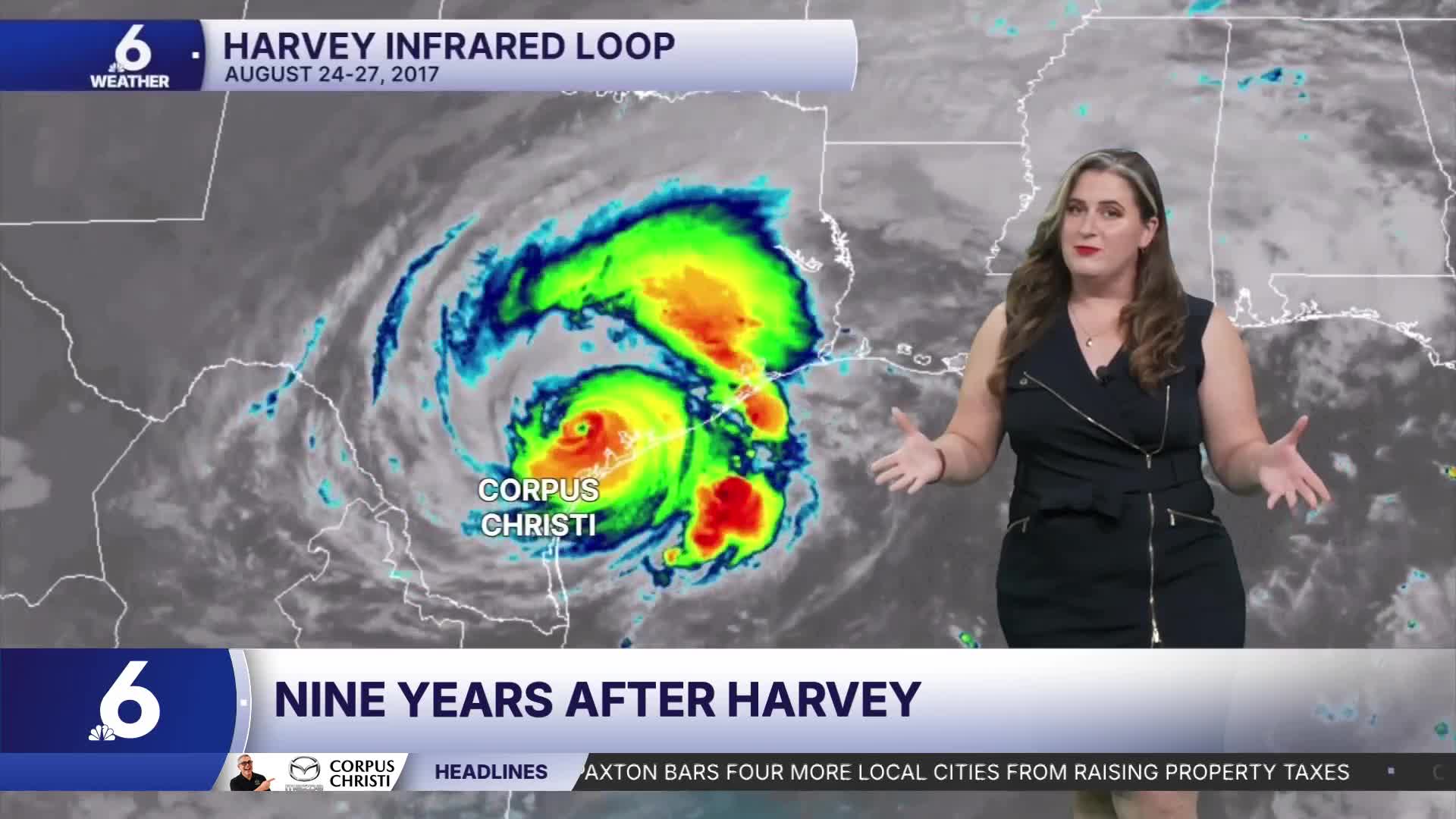


CORPUS CHRISTI, Texas — Nine years after Hurricane Harvey devastated the Rockport community and the Coastal Bend, forecasting technology has changed dramatically — and meteorologists say another major hurricane landfall is not a matter of if, but when.
Harvey was a meteorological lesson in rapid intensification. Entering the Gulf as a remnant storm, the weakened circulation quickly reorganized.
- On Wednesday, Aug. 23, the National Hurricane Center's 10 a.m. update called for Tropical Depression Harvey to become a tropical storm before making landfall along the Texas coast. A Hurricane Watch was issued.
- By 10 a.m. the next morning, Tropical Storm Harvey was expected to make landfall as a major hurricane.
- On Friday, Aug. 25, around 10 p.m., Category 4 Hurricane Harvey made landfall on San Jose Island near Rockport. Wind gusts near 140 mph were measured in the eyewall — incredible for a storm that was merely a tropical depression two days earlier.
Cory Mottice of the National Weather Service in Corpus Christi said the odds of a tropical system making landfall along the Texas coast in any given season are historically high. "The odds of any kind of tropical system making landfall along the Texas coast throughout the entire season historically is almost 90%— and that's anything from a tropical depression to a tropical storm or hurricane," Mottice said.
In 2026, Hurricane Hunters are collecting more storm data than ever before. With unmanned aerial vehicles, sail drones, and new low-altitude drones, data can now be collected where it is too dangerous for Hurricane Hunters aircraft to fly. AI is also improving hurricane forecasts. Unlike traditional models that use physics equations, AI models learn from historical storms. Google's DeepMind AI has shown promise predicting rapid intensification once a storm becomes a major hurricane. It helped the National Hurricane Center forecast 2025's Category 5 Melissa, which devastated Jamaica.
Despite the advances, Mottice said forecasts still have room to improve. "We've made significant strides in the last two decades as far as improving the rapid intensification forecast. However, we're still far from perfect on that," Mottice said. He said the Coastal Bend should not grow complacent, noting that the region is statistically overdue for another major hurricane landfall. "We average a major hurricane landfall about every 9 years. It's been about 9 years since Harvey, so we are due. It's gonna happen again. Don't know when, but historically we've gone through stretches where we have hurricane landfalls 4 out of a 6-year period. We've also gone through stretches of 10+ years with no tropical landfall and no major hurricane landfall, but it's going to happen," Mottice said.
Here's what's brewing in The Tropics:
This story was reported on-air by a journalist and has been converted to this platform with the assistance of AI. Our editorial team verifies all reporting on all platforms for fairness and accuracy.