

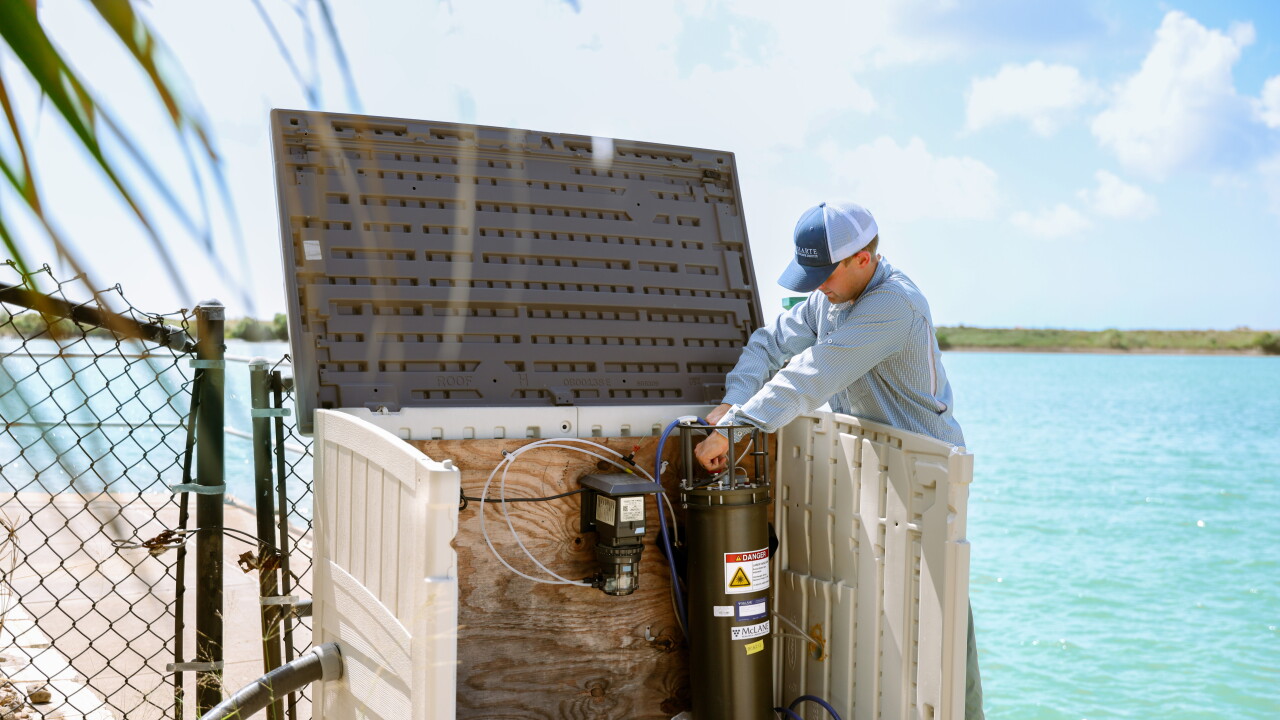

CORPUS CHRISTI, Texas — As red tide continues to affect portions of the Galveston coastline, researchers at the Harte Research Institute for Gulf of Mexico Studies are using an underwater sensor network to track whether the harmful algae could spread toward the Coastal Bend.
The institute operates a series of Imaging FlowCytobots — automated underwater instruments that detect harmful algal blooms in real time, before they become visible to the public.
Michael Wetz, the Chair for Coastal Water Health at the Harte Research Institute, said the system gives communities an advantage over traditional detection methods.
"Many times, the presence of red tide isn't known until people start seeing dead fish or experience respiratory irritation along the beach," Wetz said. "What makes our monitoring network different is that it serves as a first line of defense, helping us detect the presence of red tide early and giving communities more time to prepare."
Red tide is caused by Karenia brevis, a microscopic algae that can multiply rapidly and produce toxins harmful to marine life. The toxins can also cause respiratory irritation in people and accumulate in shellfish, creating risks for seafood harvesters and consumers.
A sensor operated by the institute at Port O'Connor — situated between Galveston and the Coastal Bend — has so far detected only low levels of the algae, according to the institute.
Laura Beecraft, an associate research scientist for Coastal Water Health at the institute, said there is no immediate concern for the Coastal Bend but cautioned that conditions can change quickly.
"Red tide blooms can move with changing currents, which is why having an instrument positioned between our region and affected areas is so important," Beecraft said. "If conditions change, we have a much better chance of detecting it early."
Red tide blooms along the Texas coast are often patchy and shift with wind, currents and tides, according to the institute. The algae typically thrive at water temperatures above roughly 75 degrees Fahrenheit and in water with salinity similar to seawater. Cooler temperatures, cold fronts and significant freshwater inflows from heavy rain can help break up blooms.
The monitoring network is expanding. New instruments are being deployed through partnerships with the Texas Parks and Wildlife Department at facilities in Flour Bluff and Rockport, as well as the Texas State Aquarium in Corpus Christi.
Funding for the network comes from the Texas OneGulf Center of Excellence and the Coastal Bend Bays and Estuaries Program, among other supporters.
This story was reported on-air by a journalist and has been converted to this platform with the assistance of AI. Our editorial team verifies all reporting on all platforms for fairness and accuracy.
For the latest local news updates, click here, or download the KRIS 6 News App.
Catch all the KRIS 6 News stories and more on our YouTube page. Subscribe today!
