

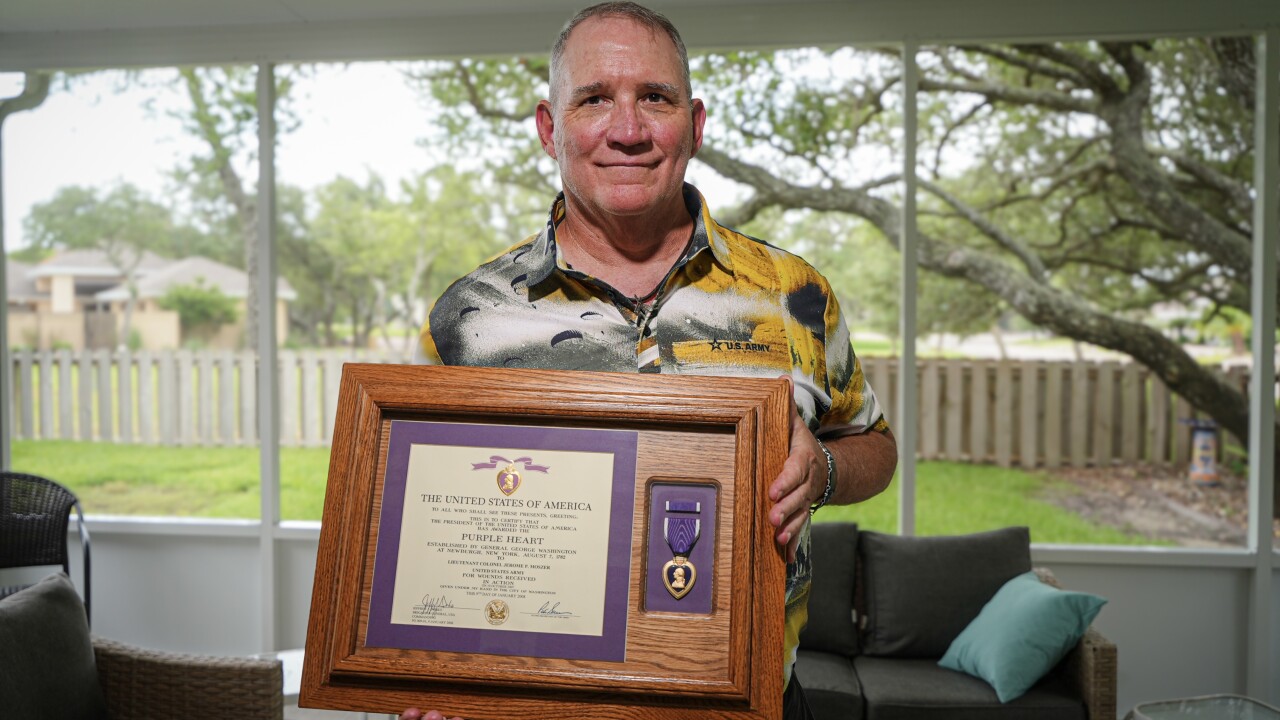


ROCKPORT, Texas — J.P. Moszer came to the Texas Coast looking for something simple.
After years of escaping North Dakota winters as a seasonal resident, he and his wife, Leslie, finally made Rockport their permanent home in 2022. They wanted a yard for their dogs, easy access to fishing and a golf course nearby.
"Rockport has the small-town feel, but it still has the amenities that you want," Moszer said. "My wife and I had three things we needed when we moved here. One was a yard for our dogs. One was to be able to fish, and the other was to be able to golf. Rockport filled all that bill."
Today, the retired Army lieutenant colonel enjoys a quiet life surrounded by two Labrador retrievers, neighbors and volunteer work.
What many people don't see is the remarkable journey that brought him here.
For 33 years, Moszer served in the U.S. Army and North Dakota National Guard, leading soldiers through deployments in Bosnia and Iraq before surviving a devastating rocket attack that left him with a Purple Heart, a traumatic brain injury and months of missing memories.
Even now, nearly two decades later, he says his greatest achievement isn't a medal or military rank.
"I didn't do it for recognition or self-promotion," Moszer said. "I did it because I love this country."
A family legacy of service
Military service wasn't originally part of Moszer's family's story.
His ancestors immigrated to the United States from Scotland and what is now Ukraine, settling in North Dakota as farmers.
That changed during World War II.
Moszer's uncle served with the 164th Infantry Regiment of the North Dakota National Guard, the first Army unit to engage in combat operations in the Pacific Theater during World War II. Another uncle served in Europe as an interpreter for the Army. Those sacrifices inspired generations that followed.
"My uncle served in World War II, and that was the start of our military career," he said. "Right now, we have almost 300 years of military service just within the family."
At just 17 years old, Moszer enlisted in the North Dakota National Guard in November 1980.
His motivation was practical. His family couldn't afford to send all of the children to college.
"My dad and my grandpa always told me, 'Nobody can take your education,'" he recalled. "'They can never take that away from you.'"
Military tuition assistance made college possible.
What started as a way to pay for school became a career spanning more than three decades.
Learning to lead
Moszer began as an enlisted field radio operator before attending Officer Candidate School and earning a commission as an engineer officer.
Throughout his career, he served as a platoon leader, company executive officer, company commander, battalion staff officer, brigade engineer and reconstruction leader in Baghdad.
But when asked about his accomplishments, he rarely mentions his own. Instead, he credits the soldiers around him.
"My accolades aren't hanging on a wall for everybody else to see because my team earned them for me," he said. "I didn't earn those myself. That's the military. We're a team."
He also credits one person above everyone else: his wife. For years, deployments often meant leaving home with only a few days' notice.
"It was, 'Hi honey, I'm home. Oh, by the way, I'm leaving again in three days,'" Moszer said.
While he deployed around the world, Leslie kept life moving at home.
"She was the rock of the family," he said. "She still is."
The day everything changed
In 2007, Moszer deployed to Iraq as part of President George W. Bush's troop surge.
The combat environment was intense. His convoy encountered multiple improvised explosive devices during the deployment. One explosion damaged his vehicle. Another nearly killed his security team.
Then, in October 2007, everything changed.
Moszer had stopped at a market on base after discovering they were out of Diet Coke. He grabbed two drinks and tucked them into his pockets. Moments later, 16 Katyusha rockets slammed into the area.
"I don't remember anything for several months," he said.
The attack left him with injuries to his shoulder, hip, knee and foot. More significantly, it caused a severe traumatic brain injury.
"The brain tissue actually sheared," he said. "I couldn't walk. I couldn't talk. I couldn't do math. I couldn't tie my shoes. I didn't know my wife."
One memory survived
For weeks, Leslie called her husband while he recovered. Each conversation ended the same way. He didn't recognize her.
“She would talk to me on the phone, [and say] ‘Do you remember me? Do you remember I'm your wife?’ And I was like, ‘nope, I'm not married.’” Moszer recalled.
Then one day she asked about someone else, Lindy.
"I finally said, 'Lindy? That's my dog,'" Moszer said.
It was the first memory that returned.
"That was the first time Leslie sort of knew it was going to be ok,” he added.
Lindy became more than a pet.
She later helped him through nightmares and the emotional effects of his injuries.
"When I'd get violent at night, she'd nudge me," he said. "She'd lick my face to wake me up and bring me back."
Living with invisible wounds
Although Moszer appears healthy today, he continues living with the lasting effects of traumatic brain injury. He experiences chronic vertigo caused by nerve damage. He also has apraxia, a neurological condition affecting motor planning and spatial processing. Doctors continue studying his recovery.
"I didn't lose a limb," he said. "I didn't suffer a catastrophic loss, but on the inside..."
Some symptoms remain difficult to explain. He said, he sometimes becomes intensely focused on small details. Other times, he relies on mental shortcuts he developed while rebuilding his brain.
"I call them cheats," he said with a laugh. "They're really hacks."
Occupational therapy challenged him to remember number sequences. Drawing on his experience as a former auctioneer, he unconsciously turned the exercises into rhythmic chants. His therapists were fascinated.
"They'd ask me how I came up with that system," he said. "I didn't even know I was doing it."
Recovery also meant relearning everyday tasks.
"When the Army asked me what I wanted to do," Moszer said, "I told them I wanted to get my master's degree."
He earned it.
"They sent me back to school, and I had to learn to read, write, everything people take as normal."
A life of service continues
Retirement didn't end Moszer's commitment to serving others. Today, he volunteers with Good Samaritan's food pantry, helping families in need throughout the Coastal Bend. His motivation comes from the same Army values that guided his military career: loyalty, duty, respect, selfless service, honor, integrity and personal courage.
"There are others out here who need my help," he said. "If you're willing to listen, I'll help you."
His wife occasionally teases him about always finding another volunteer opportunity.
"My bride will ask, 'How come you have to go down there and do that?'"
His answer never changes.
"It's my calling."
Looking back
Moszer doesn't display shelves of military awards in his home. Visitors won't find walls filled with medals. Instead, they'll find family photographs, fishing gear, playful Labradors and a wooden sign that says “Welcome to our little piece of Texas."
That's exactly how he wants it.
"When I leave this earth," he said, "I'm just a small-town boy from North Dakota that made a positive impact on the world. I didn't do it for recognition or self-promotion. I did it because I love this country."
More Veterans In Focus stories are available here, along with resources for local veterans.
Contact Veterans In Focus reporter Michelle Hofmann at michelle.lorenzo@kristv.com
