


As construction of NAS Corpus Christi was nearing an end in March of 1941, the government continued to increase appropriations for the Navy’s needs. An additional $16,000,000 was provided for construction of 3 auxiliary airfields in outlying areas around the city. These fields were originally designated P-1, P-2, and P-3. P-1 would eventually be named “Rodd Field”, P-2 became “Cabaniss Field”, and P-3 was named “Cuddihy Field”. In 1942, the Navy would also add “Waldron Field” in Flour Bluff to the list of auxiliary fields. Cuddihy would be used for “basic training” of student pilots, Rodd Field and Cabiness Field would be used for “primary training”, Waldron for “carrier landing” practice. The main base would only be used by “advanced” student pilots. Naval Air Stations would also be constructed at Kingsville and Beeville to support the mission of NAS Corpus Christi.
__________________________________________________
READ ALL THREE PARTS:
THE NAVY COMES TO CORPUS CHRISTI - PART 1
THE NAVY COMES TO CORPUS CHRISTI - PART 2
THE NAVY COMES TO CORPUS CHRISTI - PART 3
__________________________________________________
Nueces Transportation, which operated the City’s bus lines, constructed a bus terminal at Water Street and Schatzell specifically for Navy personnel. Buses made over 200 runs daily from downtown to the Naval Air Station and all of the auxiliary airfields.

Naval Air Station Corpus Christi was officially commissioned on March 12, 1941. The station was expected to take two years to build, but it opened just eight months after construction began. Secretary of the Navy, Frank Knox, presided over the opening ceremonies. Twelve members of Congress, the Governor of Texas (Pappy O’Daniel), 200 Navy officers, 1,000 enlisted men, and city, county, and state officials attended the ceremony.
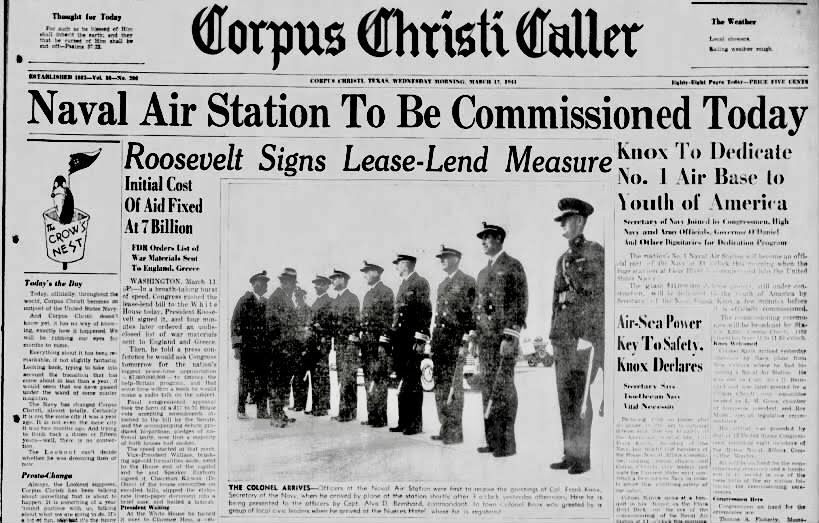
Construction on the base would continue for the next 3 months. There were over 460 buildings already completed. These included airplane hangers, an administration building, housing, commissary, a chapel, mess halls, workshops, warehouses, a hospital, post office, theater, library, and bowling alley. In December 1942 the Navy bought nearby Ward Island. The 258 acre island was used as a radar station and for the training of men in aviation electronics. It was named the “Naval Air Technical Training Center”. During WWII, the center trained over 10,000 naval technicians.

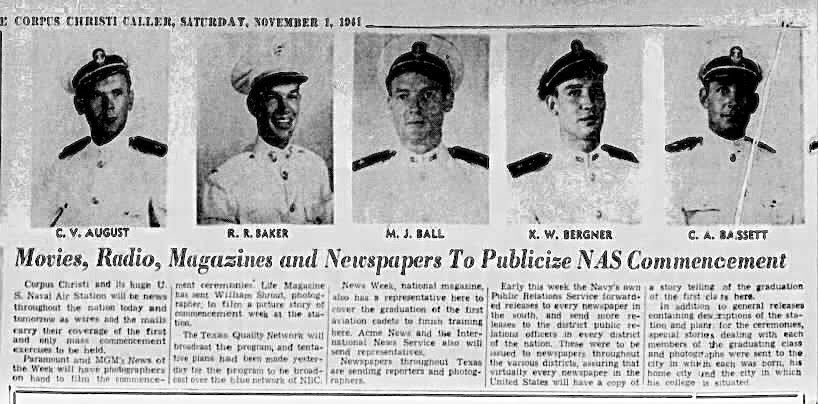
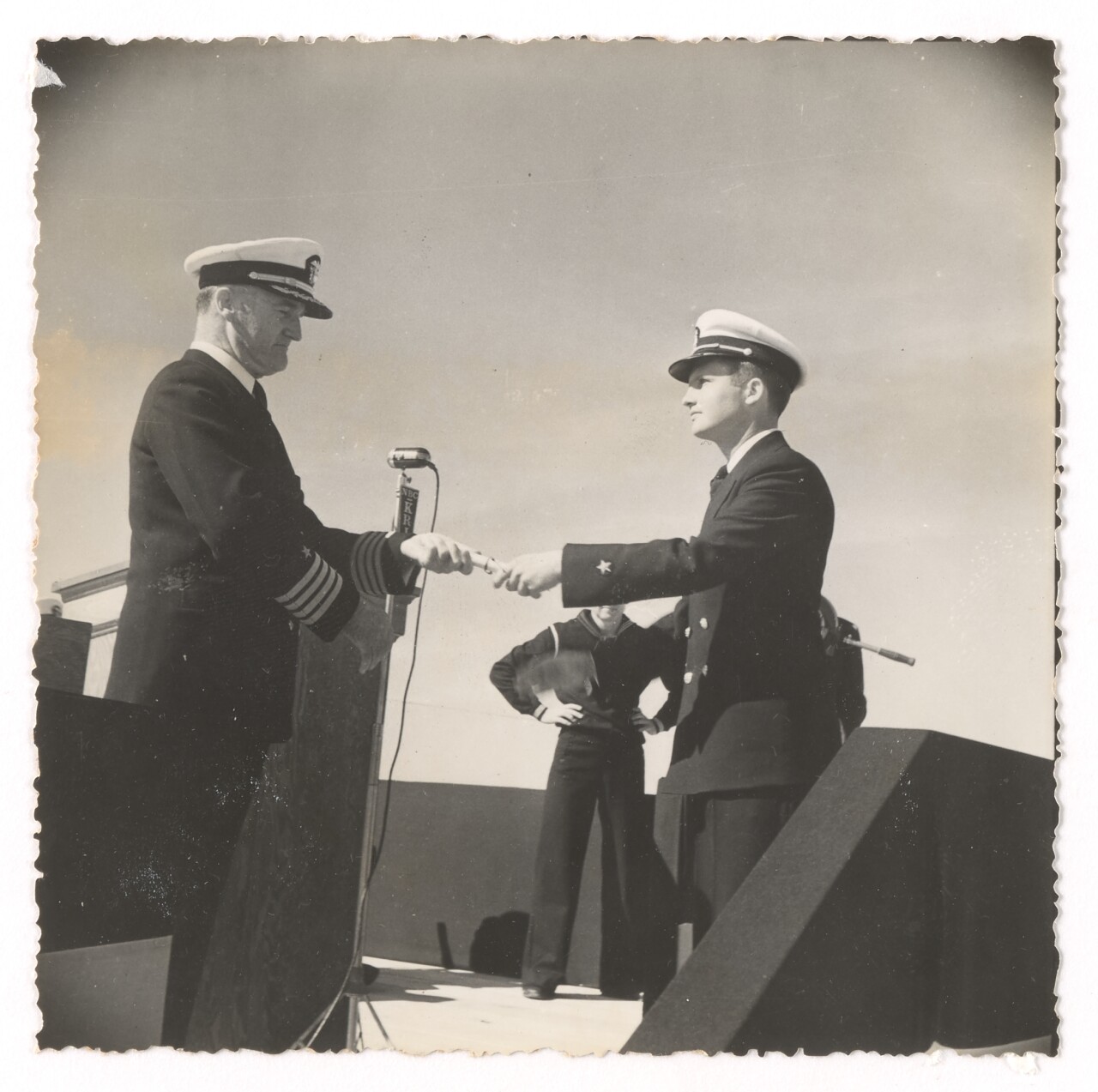
The first 50 new cadets at NAS Corpus Christi began their classes to become naval pilots on March 20, 1941. Their initial flight training would begin on May 5. By June 1941 more than 250 aviation students were on the base, and by September 1941 almost 2,000 were receiving training. The first class of 50 cadets received their “Wings of Gold” on November 1, barely six months after starting their training. Each was given their commissions as Ensigns in the U.S. Navy. After the ceremony, each was given a booklet that described in detail the proper conduct expected of them as new Naval officers. The last entry in the booklet read: “Furthermore, the good name of Corpus Christi in the fleet and elsewhere is entrusted to you. Your behavior, both as an officer and a flier, will reflect upon your training here”.
By February 1942 more than 1,400 civilian employees, both men and women, were at the base working in the maintenance and repair department. Like the enlisted men being trained as pilots, the civilians wore uniforms that displayed their chosen motto…. “We Keep Them Flying”. The pilot training program at NAS Corpus Christi was now being described as the “University of the Air”. As new pilots received their wings, they were then being assigned to bombing, fighting, or torpedo squadrons. Some were assigned to active ships, and some were sent to various naval air stations to become flight instructors. By November 1941, more than 300 new student pilots per month arrived to start their training. More than 800 instructors and 1,000 airplanes of every type were being used for that training. By 1943, the government had spent more than $54 million to construct NAS Corpus Christi and its auxiliary fields. The entire naval facility encompassed over 14,000 acres of Gulf Coast land…..making NAS Corpus Christi the largest naval air station in the world! Most of the aviation students were young men in their early 20’s. But there were exceptions. Nineteen year old George H. W. Bush received his wings at NAS Corpus Christi in 1943 to become the youngest naval pilot in WWII. Actor Tyrone Power, future TV game show host, Bob Barker, major league pitcher Warren Spahn, baseball great Ted Williams, future astronaut John Glenn, and movie star Buddy Rogers all trained at NAS Corpus Christi. By the end of WWII, more than 35,000 students had received their “Wings of Gold” at NAS Corpus Christi. There is no doubt that NAS Corpus Christi played a major role in the winning of World War II.
NAS CORPUS CHRISTI….Post World War II coming in Part 3
